
The word complicated describes something that has many connected parts, is difficult to understand, or is hard to deal with. You might use it for a difficult problem, a detailed process, a confusing situation, or an issue with many factors. The best alternative depends on exactly what makes something complicated.
People often look for synonyms because the same word can become repetitive. In professional writing, complex, intricate, or multifaceted may sound more precise. In everyday conversation, tricky, tough, or hard to figure out may feel more natural. This guide explains more than 45 alternatives and shows where each one fits best.
Quick Answer
The best synonyms for complicated include complex, intricate, elaborate, convoluted, sophisticated, multifaceted, challenging, difficult, involved, confusing, tricky, demanding, cumbersome, technical, detailed, and nuanced. Some are exact or close alternatives, while others describe a specific kind of difficulty, structure, or confusion.
Quick List of Alternatives
Closest Synonyms
- Complex
- Intricate
- Elaborate
- Convoluted
- Involved
- Multifaceted
- Sophisticated
- Detailed
- Difficult
- Challenging
Formal Alternatives
- Multifaceted
- Intricate
- Convoluted
- Sophisticated
- Elaborate
- Nuanced
- Rigorous
- Technical
- Cumbersome
- Demanding
Neutral Alternatives
- Complex
- Difficult
- Involved
- Detailed
- Challenging
- Confusing
- Unclear
- Tricky
- Layered
- Demanding
Casual Alternatives
- Tricky
- Tough
- Messy
- Confusing
- Hard to figure out
- A lot to handle
- A headache
Contextual Alternatives
- Technical
- Multifaceted
- Cumbersome
- Demanding
- Unclear
- Confusing
- Challenging
- Elaborate
Formal Alternatives to Complicated

Complex
Meaning: Something with many connected parts or factors.
Explanation: Complex is one of the closest alternatives to complicated. It often sounds more neutral and professional.
Example: The company developed a complex system for managing customer data.
Best Use: Business, academic, technical, and professional writing.
Worst Use: Avoid it when you simply mean something is difficult. A task can be difficult without being complex.
Tone: Neutral to formal.
Intricate
Meaning: Something with many small or carefully connected details.
Explanation: Intricate focuses on structure, detail, or fine parts rather than difficulty alone.
Example: The engineer designed an intricate network of cables.
Best Use: Designs, systems, processes, artwork, plans, and detailed structures.
Worst Use: It may sound unnatural for a simple task that only requires effort.
Tone: Formal and descriptive.
Elaborate
Meaning: Detailed, carefully developed, or containing many parts.
Explanation: Elaborate can describe something highly detailed. It does not always mean difficult.
Example: The team created an elaborate plan for the event.
Best Use: Plans, designs, explanations, systems, and arrangements.
Worst Use: Do not use it when you specifically mean confusing or difficult.
Tone: Formal and descriptive.
Sophisticated
Meaning: Advanced, highly developed, or technically complex.
Explanation: Sophisticated can suggest complexity combined with skill or advanced design. It often has a positive meaning.
Example: The laboratory uses sophisticated equipment.
Best Use: Technology, systems, methods, products, and professional settings.
Worst Use: Avoid it if you only mean confusing or difficult.
Tone: Professional and polished.
Multifaceted
Meaning: Having several different aspects or sides.
Explanation: Multifaceted describes something with many dimensions. It is useful when the issue cannot be understood from one angle.
Example: Climate policy is a multifaceted issue involving economic and environmental concerns.
Best Use: Academic, business, social, and analytical writing.
Worst Use: It may be too formal for a simple everyday problem.
Tone: Formal and analytical.
Convoluted
Meaning: Extremely complicated and difficult to follow.
Explanation: Convoluted is stronger than complicated and often carries a negative meaning. It can suggest unnecessary complexity.
Example: The report used a convoluted explanation that confused the readers.
Best Use: Criticizing unclear writing, systems, arguments, or procedures.
Worst Use: Avoid it when the complexity is useful or intentional.
Tone: Formal and often critical.
Nuanced
Meaning: Containing small but important differences or details.
Explanation: Nuanced does not mean simply complicated. It highlights subtle distinctions that require careful thought.
Example: The issue requires a nuanced response.
Best Use: Academic writing, analysis, opinions, and sensitive topics.
Worst Use: Do not use it for a complicated machine or physical process.
Tone: Formal and thoughtful.
Technical
Meaning: Involving specialized knowledge, methods, or terminology.
Explanation: Technical describes a particular type of complexity. Something can be technical without being confusing.
Example: The technician gave us a technical explanation of the problem.
Best Use: Technology, science, engineering, medicine, and specialized work.
Worst Use: Avoid it when the problem has no specialized component.
Tone: Professional and precise.
Cumbersome
Meaning: Difficult to use, manage, or handle.
Explanation: Cumbersome focuses on inconvenience rather than intellectual complexity.
Example: The old registration process was cumbersome and time-consuming.
Best Use: Procedures, systems, tools, paperwork, and processes.
Worst Use: It is not the best choice for a complicated theory or idea.
Tone: Formal and mildly negative.
Rigorous
Meaning: Very thorough, careful, and demanding.
Explanation: Rigorous is not a direct synonym for complicated. It describes a high level of care, precision, or strictness.
Example: The researchers followed a rigorous testing procedure.
Best Use: Academic, scientific, and professional writing.
Worst Use: Avoid it when you only want to say that something contains many parts.
Tone: Formal and positive.
Demanding
Meaning: Requiring considerable effort, skill, or attention.
Explanation: Demanding describes difficulty from the user’s point of view. It does not necessarily mean complicated in structure.
Example: The training program is demanding but rewarding.
Best Use: Tasks, jobs, courses, projects, and responsibilities.
Worst Use: Do not use it to describe a complex object unless the focus is on the effort required.
Tone: Neutral to formal.
Semi-Formal and Neutral Alternatives
Difficult
Meaning: Not easy to understand, complete, or manage.
Explanation: Difficult is broader than complicated. It focuses on the level of challenge rather than the number of parts.
Example: We faced a difficult decision.
Best Use: Everyday, professional, and academic writing.
Worst Use: Avoid it when you specifically want to emphasize a complex structure.
Tone: Neutral.
Involved
Meaning: Having many steps, details, or parts.
Explanation: Involved works well when a process requires several stages or careful attention.
Example: Applying for the position involves a detailed interview process.
Best Use: Procedures, tasks, projects, and processes.
Worst Use: It can sound vague if the reader needs to know exactly what makes something complicated.
Tone: Neutral to formal.
Tricky
Meaning: Difficult because it requires care, skill, or careful judgment.
Explanation: Tricky often describes something that looks simple but has a hidden challenge.
Example: The last part of the assignment was tricky.
Best Use: Everyday conversation, school, and informal professional communication.
Worst Use: Avoid it in highly formal reports when a more precise word is available.
Tone: Neutral to casual.
Confusing
Meaning: Difficult to understand or interpret.
Explanation: Confusing focuses on the effect something has on the reader or listener.
Example: The instructions were confusing.
Best Use: Instructions, explanations, messages, websites, and conversations.
Worst Use: Do not use it if something is simply detailed but still easy to understand.
Tone: Neutral.
Unclear
Meaning: Not easy to understand or interpret.
Explanation: Unclear is useful when the problem comes from missing, vague, or poorly presented information.
Example: The project requirements remain unclear.
Best Use: Emails, instructions, policies, reports, and workplace communication.
Worst Use: Avoid it when the information is clear but technically complex.
Tone: Neutral and professional.
Challenging
Meaning: Requiring effort, skill, or careful thought.
Explanation: Challenging is often more positive than difficult. It can suggest an opportunity to learn or improve.
Example: The new assignment is challenging but interesting.
Best Use: Education, work, personal development, and professional communication.
Worst Use: It may sound too positive when you need to strongly criticize a problem.
Tone: Neutral to positive.
Detailed
Meaning: Containing many pieces of information or small points.
Explanation: Detailed does not mean complicated by itself. It simply emphasizes the amount of information.
Example: She provided a detailed explanation of the procedure.
Best Use: Reports, instructions, explanations, and plans.
Worst Use: Avoid it when the main issue is confusion or difficulty.
Tone: Neutral.
Layered
Meaning: Having several levels, aspects, or meanings.
Explanation: Layered is useful when something develops across multiple levels.
Example: The novel presents a layered discussion of identity.
Best Use: Literature, analysis, storytelling, and complex ideas.
Worst Use: It may sound unusual for a basic mechanical process.
Tone: Neutral to sophisticated.
Demanding
Meaning: Requiring significant time, energy, or attention.
Explanation: This word emphasizes the effort required rather than the structure of the task.
Example: Managing the project was demanding.
Best Use: Jobs, projects, schedules, and responsibilities.
Worst Use: It is not a direct replacement for complicated in every sentence.
Tone: Neutral.
Technical
Meaning: Connected with specialized knowledge or skills.
Explanation: Technical works when complexity comes from specialized information.
Example: The manual contains technical instructions.
Best Use: Science, technology, engineering, and professional training.
Worst Use: Avoid it for ordinary personal problems.
Tone: Professional.
Difficult to Understand
Meaning: Not easy to grasp or interpret.
Explanation: This phrase directly describes a comprehension problem.
Example: The professor’s first explanation was difficult to understand.
Best Use: Clear, direct communication.
Worst Use: It can be wordier than a single adjective such as confusing.
Tone: Neutral.
Hard to Manage
Meaning: Difficult to control, organize, or handle.
Explanation: This phrase focuses on practical difficulty rather than intellectual complexity.
Example: The large project became hard to manage.
Best Use: Work, projects, teams, and responsibilities.
Worst Use: Avoid it when discussing complicated theories or explanations.
Tone: Neutral.
Informal and Casual Alternatives
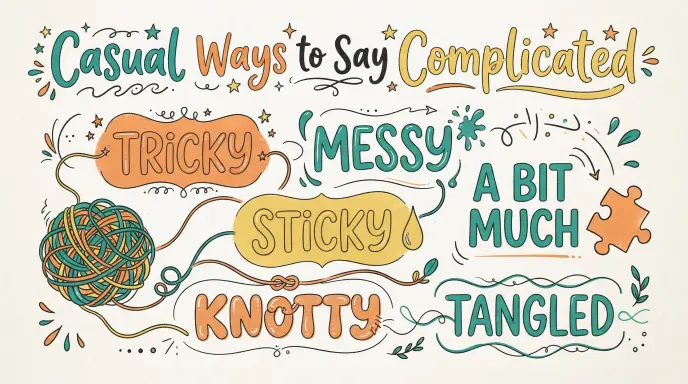
Tricky
Meaning: Something that requires extra care or thought.
Example: That question is a little tricky.
When it sounds natural: Casual conversation, school, and friendly messages.
When to avoid it: Formal reports or legal documents.
Tone: Casual and approachable.
Tough
Meaning: Difficult to deal with or complete.
Example: This has been a tough problem to solve.
When it sounds natural: Everyday conversation and informal writing.
When to avoid it: Formal academic or corporate writing.
Tone: Casual.
Messy
Meaning: Disorganized, confusing, or difficult to sort out.
Example: The situation became messy after several people changed the plan.
When it sounds natural: Personal conversations and informal workplace discussions.
When to avoid it: Formal reports where you need precise wording.
Tone: Casual and slightly negative.
Hard to Figure Out
Meaning: Difficult to understand or solve.
Example: This software is hard to figure out at first.
When it sounds natural: Everyday conversation.
When to avoid it: Formal or academic writing.
Tone: Very conversational.
A Lot to Handle
Meaning: Something requires significant attention or effort.
Example: Moving to a new city can be a lot to handle.
When it sounds natural: Personal conversations and informal messages.
When to avoid it: Formal professional writing.
Tone: Casual and empathetic.
A Headache
Meaning: A situation that causes frustration or difficulty.
Example: Fixing the old system has become a real headache.
When it sounds natural: Casual conversation.
When to avoid it: Formal communication, academic work, and customer-facing writing.
Tone: Informal and expressive.
True Synonyms vs. Contextual Alternatives
The alternatives above do not all have the same meaning. Complex and intricate can often replace complicated, while confusing, demanding, and cumbersome describe specific types of difficulty.
| Type | What It Means | Can It Replace the Original? |
|---|---|---|
| True or close synonym | Similar overall meaning | Usually |
| Near synonym | Similar but slightly different meaning | Sometimes |
| Contextual alternative | Works in a specific situation | Only in certain contexts |
| Broader expression | Covers a wider meaning | Depends on context |
| Narrower expression | Describes one specific type of complexity | Only when that meaning fits |
A useful rule is simple: choose the word that explains why something is complicated. If it is difficult to manage, use cumbersome.
Business Writing
Business writing often benefits from replacing complicated with a more precise word.
Use complex for systems, strategies, or markets:
The company operates in a complex market.
Use challenging for tasks or situations:
The team faced a challenging deadline.
Cumbersome for inefficient processes:
The current approval process is cumbersome.
Use multifaceted for issues with several dimensions:
Customer retention is a multifaceted business challenge.
Corporate Communication
Complex Business Issues
Use complex when a business issue contains several connected factors.
The company is reviewing a complex set of operational issues.
Intricate Procedures
Use intricate when a procedure contains many detailed steps.
The manufacturing process requires intricate quality checks.
Challenging Decisions
Use challenging when leaders must make a difficult choice.
The board faced a challenging decision about the expansion.
Academic Writing
Complex Ideas
Complex works well for theories, systems, and concepts with several connected elements.
The study explores the complex relationship between language and culture.
Intricate Arguments
Intricate can describe arguments with many connected points.
The author develops an intricate argument throughout the paper.
Multifaceted Topics
Multifaceted is useful when a subject has several important dimensions.
Poverty is a multifaceted social issue.
Customer Service
Customer-facing communication should usually avoid words that sound unnecessarily negative or technical.
Instead of:
Your request is complicated.
Try:
Your request involves several steps, so we will review each part carefully.
Or:
This process has a few additional requirements.
These alternatives sound clearer and more helpful.
Legal Writing
Complex Legal Matters
Legal documents often involve several rules, conditions, and interpretations. Complex is usually safer than a casual word such as tricky or messy.
The case involves complex contractual issues.
Intricate Requirements
Use intricate when you need to emphasize detailed requirements.
The agreement contains intricate reporting requirements.
Complicated Procedures
In legal writing, do not replace complicated automatically. The original word may sometimes be clearer than a more specialized alternative. Legal language depends heavily on exact meaning, so precision should come before variety.
Email Communication
Professional Alternatives for Difficult Situations
Instead of:
This is a complicated situation.
You might write:
This is a challenging situation that requires careful review.
Professional Alternatives for Complex Tasks
Instead of:
The task is complicated.
Try:
The task involves several detailed steps.
Professional Alternatives for Unclear Issues
Instead of:
Your instructions are complicated.
Use:
Some parts of the instructions are unclear. Could you clarify those points?
Email Examples
Explaining a Complex Project
Subject: Project Scope Update
Hi Daniel,
The project involves several complex requirements, so we are reviewing each stage before moving forward. I will send you the updated timeline once the review is complete.
Best,
Sarah
Discussing a Difficult Situation
Subject: Update on the Current Issue
Hi James,
We are dealing with a challenging situation, but the team is working through the main issues. I will share another update after our meeting tomorrow.
Best,
Mia
Asking for Clarification
Subject: Clarification Needed
Hi Professor Lee,
I have reviewed the assignment instructions, but one section remains unclear to me. Could you please clarify what you expect in the final analysis?
Thank you,
Alex
Updating a Client
Subject: Project Process Update
Hi Olivia,
The approval process is more involved than we initially expected. We are completing the required steps and will keep you informed as the project progresses.
Best regards,
Daniel
Explaining a Technical Issue
Subject: Technical Issue With the System
Hi Mark,
The issue appears to involve a technical configuration rather than a simple software error. Our team is reviewing the settings and will provide an update shortly.
Best,
Emma
Short Dialogue Examples
Workplace Conversation
Person A: Why is the new approval process taking so long?
Person B: It has several steps, so it is more involved than the old process.
Classroom Conversation
Person A: Did you understand the last question?
Person B: Not completely. It was pretty tricky.
Customer Service Conversation
Person A: Why does this request require so many steps?
Person B: The process is a little complex, but I can guide you through it.
Casual Conversation
Person A: How did the meeting go?
Person B: Honestly, it was a bit messy. Too many people had different ideas.
Professional Discussion
Person A: Is the problem difficult to solve?
Person B: Yes, but the main challenge is that the issue is multifaceted.
How to Replace “Complicated” in a Sentence
Replacing Complicated With Complex
Original: The system is complicated.
Alternative: The system is complex.
Why it works: Complex focuses on the system’s many connected parts and sounds professional.
Replacing Complicated With Intricate
Original: The design is complicated.
Alternative: The design is intricate.
Why it works: Intricate emphasizes detailed construction rather than difficulty.
Replacing Complicated With Convoluted
Original: The explanation was complicated.
Alternative: The explanation was convoluted.
Why it works: Convoluted suggests that the explanation was unnecessarily difficult to follow.
Replacing Complicated With Challenging
Original: The assignment was complicated.
Alternative: The assignment was challenging.
Why it works: Challenging focuses on the effort needed to complete the assignment.
Replacing Complicated With Difficult
Original: The problem is complicated.
Alternative: The problem is difficult.
Why it works: Difficult emphasizes the challenge rather than the structure of the problem.
Replacing Complicated With Multifaceted
Original: The issue is complicated.
Alternative: The issue is multifaceted.
Why it works: Multifaceted shows that the issue has several important aspects.
Replacing Complicated With Tricky
Original: The question is complicated.
Alternative: The question is tricky.
Why it works: Tricky sounds more natural in casual conversation and suggests that the question requires careful thought.
Replacing Complicated With Cumbersome
Original: The process is complicated.
Alternative: The process is cumbersome.
Why it works: Cumbersome indicates that the process is difficult to use or manage, not merely detailed.
Comparison Table of Alternatives
| Phrase | Tone | Meaning / Scope | Best Use | Example |
|---|---|---|---|---|
| Complex | Neutral/formal | Many connected parts | Business, academic writing | A complex system |
| Intricate | Formal | Many fine details | Designs, systems | An intricate design |
| Elaborate | Formal | Highly detailed | Plans, arrangements | An elaborate plan |
| Convoluted | Formal/negative | Difficult to follow | Poor explanations | A convoluted argument |
| Multifaceted | Formal | Many aspects | Analysis | A multifaceted issue |
| Sophisticated | Professional | Advanced or developed | Technology | A sophisticated system |
| Difficult | Neutral | Hard to do or understand | General use | A difficult task |
| Challenging | Neutral | Requires effort | Work and school | A challenging project |
| Confusing | Neutral | Hard to understand | Instructions | Confusing directions |
| Tricky | Casual | Requires care | Conversation | A tricky question |
| Cumbersome | Formal | Hard to manage | Processes | A cumbersome procedure |
Which Alternative Should You Choose?
Best for Formal Writing
Choose complex, intricate, multifaceted, or convoluted, depending on the exact meaning.
Best for Business Communication
Complex, challenging, and cumbersome work well because they clearly identify different types of problems.
Best for Academic Writing
Use complex, multifaceted, intricate, or nuanced when the subject requires analysis.
Best for Legal Writing
Prefer precise terms such as complex or intricate when they accurately describe the matter. Avoid casual expressions.
Best for Professional Emails
Use complex, challenging, unclear, or involved. They sound professional without being unnecessarily formal.
Best for Everyday Conversation
Difficult, tricky, tough, and confusing are natural choices.
Best for Casual Messages
Try tricky, tough, messy, or hard to figure out.
Grammar and Usage Guide
Complicated as an Adjective
So it normally describes a noun.
We faced a complicated problem.
The instructions were complicated.
Complicated With Nouns
Common combinations include:
- complicated problem
- complicated process
- complicated situation
- complicated issue
- complicated relationship
- complicated system
- complicated procedure
Complicated by
Use complicated by when an additional factor makes something harder.
The situation was complicated by a sudden change in the schedule.
Complicated With
Complicated with can appear in certain constructions, but it is usually less natural than complicated by when describing an additional difficulty.
The project became complicated by unexpected delays.
More Complicated and Most Complicated
Use more complicated for comparisons.
This process is more complicated than the previous one.
Use most complicated for the highest degree.
That was the most complicated part of the project.
Complicated vs. Complex
The two words overlap, but they are not always identical. Complex often sounds neutral and describes many connected parts. Complicated can suggest that something is difficult to understand, handle, or solve.
Natural Word Combinations
Some natural combinations include:
- highly complicated
- extremely complicated
- unnecessarily complicated
- increasingly complicated
- surprisingly complicated
- technically complicated
Avoid stacking too many modifiers when a more precise synonym would make the sentence cleaner.
Common Mistakes to Avoid
Treating Every Alternative as an Exact Synonym
Words such as difficult, confusing, and cumbersome describe different aspects of complexity. Choose based on meaning.
Confusing Complex With Difficult
A complex task has many connected elements. A difficult task requires significant effort. One task can be both, but the words highlight different qualities.
Using Convoluted When You Only Mean Detailed
Convoluted usually carries a negative sense. Use detailed or elaborate when the complexity is intentional and useful.
Using Casual Words in Formal Writing
Words such as messy and a headache can sound unprofessional in reports or academic papers.
Using Overly Formal Words in Everyday Conversation
Multifaceted may sound unnatural when you simply want to say something is difficult.
Changing the Original Meaning
Replacing complicated with confusing changes the focus from complexity to understanding.
Using Vague Alternatives
Words such as hard can be too general. If you know what makes something complicated, choose a more precise word.
Ignoring Tone and Audience
The best synonym depends on who will read the sentence and why you are writing it.
When Not to Use “Complicated”
When “Complex” Is More Precise
If you are describing a system with many connected parts, complex often gives a clearer description.
When “Difficult” Better Describes the Problem
If the main point is that something requires effort, difficult may be more accurate.
When the Wording Sounds Too Formal
In casual conversation, tricky or tough may sound more natural than multifaceted.
When a Simpler Word Improves Readability
If your readers do not need a sophisticated word, choose a simple alternative such as hard, difficult, or unclear.
When the Meaning Could Become Unclear
Avoid replacing complicated simply to create variety. A familiar word can sometimes communicate more clearly.
When “Complicated” Is Still the Best Choice
Keep the original word when it accurately describes something that is difficult because of several connected factors. You do not need a synonym every time the word appears.
Advanced Writer Tips
Tone Control
Use complex for a neutral professional tone, intricate for detailed structures, challenging for effort-based difficulty, and tricky for casual conversation.
Professional Email Etiquette
Choose words that describe the issue without blaming the reader. Instead of saying, “Your instructions are complicated,” try, “Some parts of the instructions are unclear.”
Politeness
A precise word can make criticism sound more balanced. Challenging may feel less negative than difficult, while convoluted can sound strongly critical.
Context Alignment
Think about what makes the subject complicated. Is it the number of parts, the amount of effort, the lack of clarity, or the difficulty of managing it?
Precision
Do not choose a synonym only because it sounds sophisticated. Complex may be better than multifaceted if you are simply describing a system with many connected parts.
Readability
Short, familiar words often make writing easier to understand. If difficult communicates the idea clearly, there is no need to replace it with a more advanced term.
Related Questions
What Is Another Way to Say Complicated?
You can say complex, difficult, intricate, involved, challenging, confusing, multifaceted, elaborate, convoluted, or tricky, depending on the context.
What Is a Professional Alternative to Complicated?
Complex is usually the safest professional alternative. Multifaceted, intricate, and cumbersome can work when they describe the specific type of complexity accurately.
What Is a Formal Word for Complicated?
Common formal choices include complex, intricate, multifaceted, convoluted, sophisticated, and elaborate.
What Can I Use Instead of Complicated?
Choose difficult for general difficulty, confusing for unclear information, complex for many connected parts, and cumbersome for something difficult to manage.
Is Complicated Formal or Informal?
Complicated is a standard neutral word. It works in everyday conversation, professional writing, academic writing, and many other contexts.
Can Complex Replace Complicated?
Often, yes. However, complex emphasizes structure and relationships, while complicated can emphasize difficulty or trouble. The two are close but not identical in every sentence.
What Is the Difference Between Complex and Complicated?
Complex often describes something with many connected elements. Complicated can also describe that situation, but it more strongly suggests that the subject is difficult to understand, manage, or solve.
FAQs
What is the best synonym for complicated?
Complex is one of the closest and most versatile synonyms. Other choices depend on the context. Use intricate for detailed structures, difficult for general difficulty, and confusing when something is hard to understand.
What is a formal synonym for complicated?
Formal alternatives include complex, intricate, multifaceted, convoluted, sophisticated, and elaborate. Choose based on the specific meaning rather than formality alone.
What is another word for complicated in professional writing?
Complex is usually the most natural choice. Depending on the situation, challenging, cumbersome, multifaceted, or involved may be more precise.
What is another word for complicated and difficult?
Words such as challenging, demanding, intricate, complex, and convoluted can work, but each highlights a different aspect of the problem.
Can complex replace complicated?
Yes, in many cases. However, complex often sounds more neutral, while complicated may suggest that something creates difficulty or confusion.
What is the difference between complex and complicated?
Both can describe something with many parts or factors. Complex often focuses on structure, while complicated can focus more on difficulty, confusion, or the trouble involved.
What is a casual way to say complicated?
In casual speech, you can use tricky, tough, messy, confusing, hard to figure out, or a lot to handle, depending on what you mean.
Key Takeaways
- Complex is the most versatile professional alternative to complicated.
- Use intricate for something with many fine or detailed parts.
- Choose difficult or challenging when the main issue is effort.
- Use confusing when information is hard to understand or interpret.
- Match the synonym to the exact meaning, audience, and tone instead of changing words only for variety.
Conclusion
The best synonym for complicated depends on what makes something difficult. Complex works well for systems and ideas with many connected parts, while intricate highlights fine detail. Multifaceted suits subjects with several important aspects, and convoluted is useful when complexity makes something unnecessarily hard to follow. For everyday situations, difficult, challenging, and tricky often sound more natural.
Good word choice is not about finding the most advanced synonym. It is about choosing the word that gives readers the clearest picture. Before replacing complicated, ask whether you mean difficult, confusing, detailed, technical, demanding, or hard to manage. That small distinction can make professional, academic, and everyday writing much more precise.
