
The word pathetic can have several meanings, depending on context. It may describe something that is very poor, weak, disappointing, or deserving of pity.
For example, “a pathetic excuse” usually means a very weak or unconvincing excuse, while “a pathetic figure” can describe someone who seems helpless or pitiful.
Because the word can sound harsh or insulting, choosing another expression may make your writing more precise and appropriate.
A formal report may need words such as inadequate or deficient, while everyday conversation might use pitiful, weak, or sad. The best choice depends on exactly what you want to communicate.
Quick Answer
Useful synonyms for pathetic include pitiful, pitiable, pitifully weak, feeble, inadequate, poor, disappointing, miserable, wretched, sorry, weak, unimpressive, inadequate, deficient, ineffective, laughable, ridiculous, contemptible, hopeless, and lamentable. The right alternative depends on whether you mean deserving pity, extremely poor, weak, or embarrassingly inadequate.
Quick List of Alternatives to “Pathetic”
Closest Alternatives
- Pitiful
- Pitiable
- Miserable
- Wretched
- Sorry
- Feeble
- Weak
- Lamentable
- Sad
- Disappointing
Formal Alternatives
- Inadequate
- Deficient
- Insufficient
- Unsatisfactory
- Substandard
- Deplorable
- Lamentable
- Incompetent
- Ineffective
- Unacceptable
Neutral Alternatives
- Poor
- Weak
- Unimpressive
- Insufficient
- Disappointing
- Unsatisfactory
- Ineffective
- Inadequate
Informal Alternatives
- Sad
- Lame
- Weak
- Laughable
- Ridiculous
- Sorry
- Terrible
Formal Alternatives to “Pathetic”

Inadequate
Meaning: Not good enough for a particular purpose.
Explanation: “Inadequate” is one of the safest formal alternatives when pathetic means something is insufficient or fails to meet expectations. It does not carry the emotional or insulting force of “pathetic.”
Example: The company’s safety measures were inadequate.
Best Use: Reports, evaluations, academic writing, and professional communication.
Worst Use: Avoid it when you specifically mean that someone deserves sympathy.
Tone: Formal and objective.
Deficient
Meaning: Lacking something necessary or important.
Explanation: “Deficient” focuses on a specific weakness or missing quality. It is more precise than “pathetic” in technical and professional contexts.
Example: The proposal was deficient in supporting evidence.
Best Use: Academic, technical, business, and analytical writing.
Worst Use: It may sound unnatural in casual conversation.
Tone: Formal and analytical.
Insufficient
Meaning: Not enough to meet a need or requirement.
Explanation: This word works when something is inadequate because there is not enough of it.
Example: The evidence provided was insufficient to support the claim.
Best Use: Academic papers, reports, applications, and formal emails.
Worst Use: Do not use it if the problem is poor quality rather than quantity or adequacy.
Tone: Formal and neutral.
Unsatisfactory
Meaning: Not good enough or not acceptable.
Explanation: “Unsatisfactory” is useful when something fails to meet an expected standard.
Example: The quality of the final product was unsatisfactory.
Best Use: Workplace evaluations, customer complaints, reports, and formal feedback.
Worst Use: It may be too mild if you intend to express strong criticism.
Tone: Formal and professional.
Substandard
Meaning: Below the expected or required standard.
Explanation: This is a strong alternative when something is objectively below an accepted level of quality.
Example: The inspection revealed several substandard materials.
Best Use: Quality control, business, manufacturing, and professional writing.
Worst Use: Avoid it when discussing a person’s emotional state.
Tone: Formal and critical.
Deplorable
Meaning: Extremely bad and deserving strong criticism.
Explanation: “Deplorable” is much stronger than “inadequate.” It expresses serious disapproval.
Example: The report described the living conditions as deplorable.
Best Use: Serious criticism in formal writing.
Worst Use: Avoid it for minor mistakes because it can sound excessive.
Tone: Strong, formal, and disapproving.
Lamentable
Meaning: Regrettable, disappointing, or deserving criticism.
Explanation: This word is closely related to situations that are unfortunate or disappointing.
Example: The lack of preparation was a lamentable mistake.
Best Use: Formal essays, commentary, and professional criticism.
Worst Use: It can sound overly literary in everyday speech.
Tone: Formal and serious.
Incompetent
Meaning: Lacking the ability or skill needed to perform a task properly.
Explanation: Use “incompetent” when pathetic refers specifically to someone’s lack of ability.
Example: The manager was criticized for making several incompetent decisions.
Best Use: Situations involving skills, performance, or ability.
Worst Use: It can be insulting when directed at a person.
Tone: Strong and critical.
Ineffective
Meaning: Not producing the desired result.
Explanation: “Ineffective” is a precise choice when something fails to work.
Example: The campaign was ineffective at reaching its target audience.
Best Use: Business, marketing, academic, and professional writing.
Worst Use: It does not express pity or emotional weakness.
Tone: Neutral and professional.
Unacceptable
Meaning: Not good enough to be accepted.
Explanation: This word communicates a clear failure to meet a required standard.
Example: The level of service was unacceptable.
Best Use: Complaints, policies, workplace communication, and formal criticism.
Worst Use: It may sound too strong when discussing a minor issue.
Tone: Firm and formal.
Semi-Formal and Neutral Alternatives
Poor
Meaning: Low in quality or below expectations.
Explanation: “Poor” is a broad and natural alternative. It is usually less insulting than “pathetic.”
Example: The team delivered a poor performance.
Best Use: General writing and everyday communication.
Worst Use: Avoid it when you need to identify the exact problem.
Tone: Neutral.
Disappointing
Meaning: Failing to meet expectations.
Explanation: This word focuses on the result rather than attacking a person or object.
Example: The final result was disappointing.
Best Use: Feedback, reviews, schoolwork, and workplace communication.
Worst Use: It may be too mild for severe problems.
Tone: Neutral and polite.
Unimpressive
Meaning: Failing to create a strong or favorable impression.
Explanation: “Unimpressive” is useful when something is ordinary, weak, or less effective than expected.
Example: The presentation was competent but unimpressive.
Best Use: Reviews, evaluations, and general writing.
Worst Use: It does not necessarily mean something is seriously bad.
Tone: Neutral and mildly critical.
Weak
Meaning: Lacking strength, power, quality, or effectiveness.
Explanation: “Weak” can replace “pathetic” when the focus is on poor performance or lack of strength.
Example: The argument was weak and poorly supported.
Best Use: Arguments, performances, plans, evidence, and results.
Worst Use: It can sound insulting when applied directly to a person.
Tone: Neutral to critical.
Ineffective
Meaning: Failing to achieve the intended result.
Explanation: This is a useful professional alternative when the problem concerns results rather than appearance or emotion.
Example: The original strategy proved ineffective.
Best Use: Work, business, education, and analysis.
Worst Use: Avoid it when the intended meaning is “deserving pity.”
Tone: Professional and objective.
Unsatisfying
Meaning: Failing to provide the expected level of satisfaction.
Explanation: This works particularly well for experiences, answers, endings, or explanations.
Example: The explanation was technically correct but unsatisfying.
Best Use: Reviews, feedback, and personal commentary.
Worst Use: It is not a direct substitute for pathetic in every context.
Tone: Neutral.
Mediocre
Meaning: Only average or of ordinary quality.
Explanation: “Mediocre” is weaker than “pathetic.” It suggests something is not impressive rather than extremely poor.
Example: The restaurant received mediocre reviews.
Best Use: Reviews and evaluations.
Worst Use: Do not use it when something is genuinely disastrous or inadequate.
Tone: Mildly critical.
Unsuitable
Meaning: Not appropriate for a particular purpose.
Explanation: Use this word when the issue is fitness for a specific situation.
Example: The software was unsuitable for the company’s needs.
Best Use: Professional and practical contexts.
Worst Use: It does not describe emotional weakness or something deserving pity.
Tone: Neutral and professional.
Frail
Meaning: Physically weak or delicate.
Explanation: “Frail” is a narrower alternative. It works when pathetic refers to physical weakness, especially in a person or animal.
Example: The frail bird could barely fly.
Best Use: Physical descriptions.
Worst Use: Avoid it when criticizing quality or performance.
Tone: Descriptive and sometimes sympathetic.
Helpless
Meaning: Unable to help oneself or control a situation.
Explanation: This can replace pathetic when the intended meaning involves vulnerability or inability.
Example: The injured animal looked helpless.
Best Use: Emotional or descriptive contexts.
Worst Use: It does not mean poor quality.
Tone: Sympathetic.
Pitiful
Meaning: Deserving pity or showing extreme weakness or poor quality.
Explanation: “Pitiful” is one of the closest alternatives to “pathetic.” However, it can still sound insulting when used about a person’s efforts or abilities.
Example: The team made a pitiful attempt to defend its decision.
Best Use: Strong descriptive criticism or sympathetic contexts.
Worst Use: Avoid it when you need tactful professional feedback.
Tone: Strong, emotional, and sometimes insulting.
Informal and Casual Alternatives
Sad
Meaning: Pathetically weak, disappointing, or embarrassing in some contexts.
Example: That was a sad excuse for missing the meeting.
When it sounds natural: Casual conversation.
When to avoid it: Formal reports or professional evaluations.
Tone: Casual and critical.
Lame
Meaning: Weak, unimpressive, or disappointing.
Example: That was a lame excuse.
When it sounds natural: Informal speech and casual messages.
When to avoid it: Academic, professional, or formal communication.
Tone: Casual and dismissive.
Laughable
Meaning: So poor or unreasonable that it seems ridiculous.
Example: The amount offered was laughable.
When it sounds natural: Informal criticism and commentary.
When to avoid it: Sensitive professional situations.
Tone: Mocking and strong.
Ridiculous
Meaning: Extremely unreasonable, silly, or absurd.
Example: Their excuse was ridiculous.
When it sounds natural: Everyday conversation.
When to avoid it: Formal feedback where diplomacy matters.
Tone: Strong and dismissive.
Sorry
Meaning: Very poor, inadequate, or unimpressive.
Example: That was a sorry attempt at an apology.
When it sounds natural: Informal and literary contexts.
When to avoid it: Formal workplace communication.
Tone: Critical and somewhat old-fashioned in some uses.
Terrible
Meaning: Extremely poor or unpleasant.
Example: The service was terrible.
When it sounds natural: Everyday speech.
When to avoid it: Formal writing that requires precise criticism.
Tone: Casual and strong.
True Synonyms vs. Contextual Alternatives
Not every word listed above can replace pathetic in every sentence. The original word can describe pity, weakness, poor quality, or embarrassing inadequacy. Each alternative covers only some of these meanings.
| Type | What It Means | Can It Replace “Pathetic”? |
|---|---|---|
| True synonym | Has nearly the same meaning in the relevant context | Often |
| Near synonym | Similar meaning but with a slightly different emphasis | Sometimes |
| Contextual alternative | Works only in a specific situation | Yes, in that context |
| Broader expression | Covers a wider idea | Sometimes |
| Narrower expression | Describes one specific aspect | Only when that aspect is intended |
For example, pitiful is close to “pathetic” when something deserves pity or is extremely poor. Inadequate works when something fails to meet a standard. Ineffective is better when something simply does not produce the desired result. Helpless is appropriate when vulnerability is the main idea.
Business Writing
Business writing usually benefits from precise and objective alternatives rather than emotionally loaded words.
Instead of saying:
The proposal was pathetic.
A professional writer might say:
The proposal was inadequate and lacked sufficient supporting evidence.
Other useful choices include:
- Inadequate
- Insufficient
- Deficient
- Unsatisfactory
- Ineffective
- Substandard
- Unacceptable
These words identify the problem without unnecessarily insulting the person who produced the work.
Corporate Communication
In reports and internal communication, pathetic can sound personal or hostile. Choose wording that describes the actual problem.
For example:
The original process was ineffective and caused repeated delays.
This is clearer than:
The original process was pathetic.
Specific criticism is usually more useful than emotional criticism.
Academic Writing
Academic writing should favor precise words such as inadequate, insufficient, deficient, weak, unsupported, ineffective, and unsatisfactory.
For example:
The study provides insufficient evidence to support the conclusion.
This is more precise than:
The study provides pathetic evidence.
Academic writing should explain why something is weak instead of relying on an emotionally charged adjective.
Customer Service
Customer service communication requires tact. Instead of telling a customer that their explanation is “pathetic,” use a neutral phrase such as:
The information provided is insufficient for us to process your request.
Likewise, instead of describing a service as “pathetic,” a professional response might say:
We recognize that the service you received did not meet our expected standards.
Legal Writing
Legal writing generally requires precise language. Pathetic is usually too subjective because it expresses an emotional judgment.
Depending on the intended meaning, more precise terms may include:
- Inadequate
- Insufficient
- Deficient
- Unsupported
- Unreasonable
- Noncompliant
- Unsatisfactory
The correct legal wording depends on the document and jurisdiction. A casual synonym should not be substituted for a legal term without checking the intended legal meaning.
Email Communication
Professional emails often need softer alternatives to avoid sounding hostile. Inadequate, insufficient, incomplete, and unsatisfactory can communicate criticism more constructively.
For example:
The information in the document is incomplete, so we need a few additional details before moving forward.
This gives the recipient a clear next step instead of simply labeling the work “pathetic.”
Email Examples Using Alternatives
Client Communication — “Insufficient”
Subject: Additional Information Needed
Dear Jordan,
Thank you for sending the project details. The information currently provided is insufficient for us to prepare the final proposal.
Could you please send the updated specifications and delivery requirements? Once we receive them, we can complete the next stage.
Best,
Sam
Project Update — “Inadequate”
Subject: Project Review Update
Hi Team,
Our initial review found that the current testing process is inadequate for the new requirements.
We recommend adding two additional testing stages before the next release. This should give us a clearer picture of the system’s performance.
Best,
Sam
Internal Workplace Email — “Unsatisfactory”
Subject: Quality Review
Hi Alex,
The latest submission does not meet the required quality standards and is therefore unsatisfactory in its current form.
Please review the highlighted sections and send an updated version by Friday.
Thanks,
Sam
Customer Service — “Unacceptable”
Subject: Follow-Up on Your Service Complaint
Dear Customer,
We understand your concern regarding the delay. The service you received was below our expected standard and was not acceptable.
We are reviewing the issue and will provide an update as soon as possible.
Kind regards,
Customer Support
Academic Communication — “Weak”
Subject: Feedback on Your Draft
Hi Maya,
Your main argument is interesting, but the current evidence is weak in several places.
Consider adding stronger sources and explaining how each example supports your central claim.
Best,
Professor Lee
Short Dialogue Examples
Workplace
Person A: What did you think of the proposal?
Person B: The main idea is useful, but the evidence was inadequate.
Classroom
Person A: Why did the teacher reject my answer?
Person B: She said the explanation was too weak and needed more support.
Customer Service
Person A: How can I complain about the service?
Person B: Explain clearly which part of the service was unsatisfactory.
Casual Conversation
Person A: What did you think of his excuse?
Person B: Honestly, it was pretty lame.
Professional Discussion
Person A: Should we continue using this process?
Person B: Probably not. It has been ineffective for several months.
How to Replace “Pathetic” in a Sentence
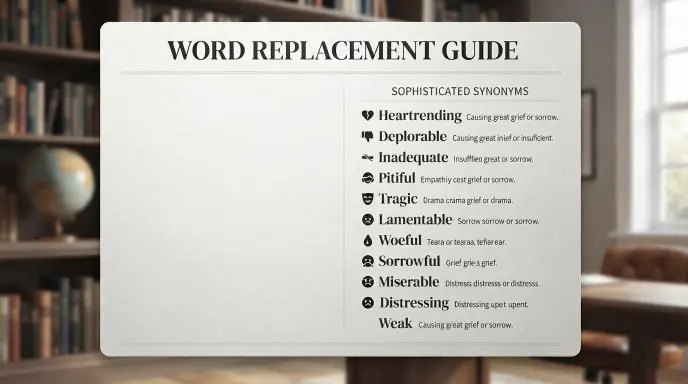
Example 1
Original: The team’s performance was pathetic.
Alternative: The team’s performance was disappointing.
Why it works: “Disappointing” sounds less insulting and focuses on the result.
Example 2
Original: He gave a pathetic excuse.
Alternative: He gave a weak excuse.
Why it works: “Weak” keeps the meaning while using a more neutral expression.
Example 3
Original: The evidence was pathetic.
Alternative: The evidence was insufficient.
Why it works: “Insufficient” explains that there was not enough evidence.
Example 4
Original: The company’s response was pathetic.
Alternative: The company’s response was inadequate.
Why it works: “Inadequate” is more professional and objective.
Example 5
Original: She looked pathetic after the accident.
Alternative: She looked helpless after the accident.
Why it works: “Helpless” focuses on vulnerability rather than making a harsh judgment.
Example 6
Original: The attempt was pathetic.
Alternative: The attempt was unsuccessful.
Why it works: “Unsuccessful” states the result without adding an insulting tone.
Example 7
Original: The service was pathetic.
Alternative: The service was unsatisfactory.
Why it works: “Unsatisfactory” is better suited to professional complaints.
Example 8
Original: His argument was pathetic.
Alternative: His argument was poorly supported.
Why it works: This version identifies the specific weakness instead of using a vague insult.
Comparison of Alternatives
| Phrase | Tone | Meaning / Scope | Best Use | Example |
|---|---|---|---|---|
| Pitiful | Emotional | Deserving pity or very poor | General criticism | It was a pitiful attempt. |
| Pitiable | Formal | Deserving sympathy | Serious descriptions | His condition was pitiable. |
| Inadequate | Formal | Not good enough | Work and reports | The plan was inadequate. |
| Deficient | Formal | Missing something needed | Academic and technical | The report was deficient in evidence. |
| Insufficient | Formal | Not enough | Academic and professional | The evidence was insufficient. |
| Unsatisfactory | Professional | Below expectations | Feedback | The result was unsatisfactory. |
| Substandard | Formal | Below an accepted standard | Quality control | The materials were substandard. |
| Ineffective | Neutral | Fails to achieve results | Business | The strategy was ineffective. |
| Disappointing | Neutral | Fails to meet expectations | General feedback | The result was disappointing. |
| Weak | Neutral | Lacking strength or quality | Arguments and performance | The argument was weak. |
| Unimpressive | Neutral | Not especially good | Reviews | The presentation was unimpressive. |
| Helpless | Sympathetic | Unable to help oneself | Personal situations | The animal looked helpless. |
| Lame | Casual | Weak or unimpressive | Informal speech | That was a lame excuse. |
| Laughable | Casual | Ridiculously poor | Informal criticism | The offer was laughable. |
| Ridiculous | Casual | Absurd or unreasonable | Conversation | That explanation is ridiculous. |
Which Alternative Should You Choose?
For Formal Writing
Choose inadequate, deficient, insufficient, unsatisfactory, or substandard. These words describe weaknesses without sounding unnecessarily emotional.
For Business Communication
Inadequate, ineffective, insufficient, and unsatisfactory are usually strong choices because they focus on performance or results.
For Academic Writing
Use insufficient, deficient, weak, unsupported, or ineffective. Academic writing benefits from precise descriptions of what is wrong.
For Legal Writing
Prefer precise terms such as insufficient, inadequate, unsupported, unreasonable, or another term that matches the legal issue. Avoid using “pathetic” as a subjective judgment.
For Professional Emails
Use inadequate, incomplete, insufficient, or unsatisfactory depending on the problem. These alternatives can communicate criticism without sounding insulting.
For Everyday Conversation
Poor, weak, disappointing, sad, lame, or terrible may sound more natural, depending on how strong you want the criticism to be.
For Casual Messages
Words such as lame, sad, ridiculous, and weak can work, but they may sound judgmental. Use them only when the informal tone is appropriate.
Grammar and Usage Guide
“Pathetic” Is Usually an Adjective
It normally comes before a noun or after a linking verb.
That was a pathetic excuse.
His attempt was pathetic.
Use “Pathetically” as an Adverb
When describing how something is done, use the adverb pathetically.
The team performed pathetically.
However, this form is strongly negative and may sound insulting.
“Pathetic” Can Describe Different Things
The intended meaning changes with the noun.
a pathetic excuse — a very weak excuse
a pathetic attempt — a poor or unsuccessful attempt
a pathetic figure — someone who appears pitiable or helpless
Because the meanings differ, the best synonym also changes.
Avoid Unclear Substitutions
Do not automatically replace “pathetic” with “inadequate.” A person can be pathetic in the sense of deserving pity, but “inadequate” usually describes performance, quality, or suitability.
Common Mistakes to Avoid
Treating Every Alternative as an Exact Synonym
Words such as helpless, inadequate, and ineffective have different meanings. Choose according to the intended context.
Using Emotional Words in Professional Writing
Calling a colleague’s work “pathetic” can sound insulting. Use a specific and objective description instead.
Choosing “Insufficient” for a Quality Problem
“Insufficient” usually means not enough, while “poor” or “substandard” may be better when the issue is quality.
Using “Incompetent” Too Broadly
“Incompetent” refers to a lack of skill or ability. It should not be used simply because a result was disappointing.
Using Casual Words in Formal Writing
Words such as lame and sad can sound inappropriate in academic or business documents.
Confusing “Pathetic” With “Pitiable”
Both can relate to pity, but pitiable more directly emphasizes deserving sympathy, while pathetic can also mean extremely poor or weak.
Using “Ridiculous” When You Mean “Poor”
Something can be poor without being absurd. “Ridiculous” adds the idea that something is unreasonable or laughable.
Ignoring the Audience
A word that sounds natural among friends may be too harsh for a client, teacher, manager, or customer.
When Not to Use “Pathetic”
In Formal Evaluations
Use inadequate, deficient, or unsatisfactory when giving professional feedback.
In Academic Writing
Choose precise terms such as weak, insufficient, unsupported, or ineffective.
In Sensitive Conversations
“Pathetic” can easily sound insulting. Pitiable, vulnerable, helpless, or a specific neutral description may be more appropriate.
When You Need Precision
If you mean that something failed, say unsuccessful or ineffective. If you mean that there was not enough evidence, say insufficient.
When a Neutral Tone Is Required
Words such as poor, disappointing, and inadequate are often safer.
When You Are Addressing a Person Directly
Calling someone “pathetic” is usually personal and harsh. Describe the specific behavior or problem instead.
When “Pathetic” Is Actually the Better Choice
The word can be appropriate when the intended tone is deliberately strong, emotional, or critical.
The character’s pathetic attempt to escape revealed how desperate he had become.
In creative writing, commentary, or informal speech, that emotional force may be exactly what the writer wants.
Advanced Writer Tips
Tone Control
Replace pathetic with inadequate for a formal tone, disappointing for a softer tone, or lame for an informal tone.
Professional Email Etiquette
Focus on the problem rather than insulting the person. Instead of “Your report is pathetic,” write:
The report needs additional evidence before it can be finalized.
Politeness
Specific criticism usually sounds more constructive than broad negative labels.
The proposal lacks supporting evidence.
is more useful than:
The proposal is pathetic.
Context Alignment
First identify what “pathetic” means in your sentence. Does it mean weak, poor, helpless, ineffective, disappointing, or deserving pity? Then choose the alternative that matches that meaning.
Precision
Avoid broad words when a specific description is available. Insufficient evidence tells readers more than pathetic evidence.
Readability
Simple words are often stronger.
Instead of:
The current strategy is fundamentally ineffective in achieving its intended objectives.
you may simply write:
The strategy does not work.
Clear writing does not require complicated vocabulary.
Related Questions
What Is Another Way to Say “Pathetic”?
Common alternatives include pitiful, pitiable, weak, poor, inadequate, disappointing, miserable, wretched, unsatisfactory, and ineffective. The best choice depends on whether you mean poor quality, weakness, failure, or something deserving pity.
What Is a Professional Alternative to “Pathetic”?
Inadequate, insufficient, unsatisfactory, deficient, ineffective, and substandard are useful professional alternatives. Choose the word that identifies the actual problem.
What Is a Formal Alternative to “Pathetic”?
Pitiable, lamentable, deplorable, inadequate, deficient, and unsatisfactory can work in formal contexts, although their meanings and emotional strength differ.
Is “Pathetic” a Formal Word?
“Pathetic” is grammatically suitable for formal writing, but it is often emotionally loaded. In professional or academic writing, a more precise alternative may communicate the intended criticism better.
Can “Weak” Replace “Pathetic”?
Sometimes. Weak works when “pathetic” means lacking strength, quality, evidence, or effectiveness. It does not replace the sense of deserving pity.
What Is the Difference Between “Pathetic” and “Pitiful”?
Both can describe something deserving pity or being extremely poor. Pitiful often emphasizes pity, while pathetic can also describe something weak, inadequate, or embarrassingly poor.
What Is the Difference Between “Pathetic” and “Inadequate”?
“Inadequate” means something is not good enough for a particular purpose. “Pathetic” is more emotional and can suggest extreme weakness, poor quality, or contempt.
FAQs:
Is “pathetic” a negative word?
Yes. “Pathetic” is generally negative and can sound insulting when used about a person. It can describe something very weak, poor, disappointing, or deserving pity.
What is the nicest way to say “pathetic”?
For polite communication, try disappointing, inadequate, unsatisfactory, ineffective, or in need of improvement, depending on what you mean.
What is the strongest synonym for “pathetic”?
Words such as deplorable, contemptible, pitiful, and wretched can be very strong, but they do not have exactly the same meaning. The strongest choice depends on the context.
Can I use “pathetic” in an essay?
Yes, but use it carefully. Academic writing usually benefits from precise words such as weak, insufficient, inadequate, unsupported, or ineffective.
Is “pitiful” stronger than “pathetic”?
Not always. Both can be strong, emotional words. “Pitiful” often focuses more directly on pity, while “pathetic” has additional meanings related to weakness and poor quality.
Is “lame” a synonym for “pathetic”?
“Lame” can be a casual alternative when “pathetic” means weak, unimpressive, or disappointing. It is informal and should generally be avoided in academic or professional writing.
How can I avoid sounding rude when replacing “pathetic”?
Describe the specific problem instead of labeling it. For example, replace “a pathetic argument” with “an argument with insufficient evidence” when that is what you actually mean.
Key Takeaways
- Pathetic can mean pitiful, weak, poor, disappointing, or deserving pity.
- Use inadequate, insufficient, or unsatisfactory for professional writing.
- Choose weak, poor, or disappointing for neutral everyday contexts.
- Words such as lame and sad are more casual and can sound dismissive.
- Always choose a synonym based on the exact meaning, audience, and tone.
Conclusion:
Choosing a synonym for pathetic is not simply a matter of finding another negative adjective. The word can describe poor quality, weakness, failure, helplessness, or something that deserves pity. Each meaning calls for a different replacement.
For professional and academic writing, inadequate, insufficient, deficient, ineffective, and unsatisfactory are often more precise. In everyday writing, poor, weak, disappointing, and unimpressive sound natural. Casual conversations may allow words such as lame, sad, or ridiculous, although these can sound harsh.
The most effective approach is to identify what you actually mean before choosing a replacement.
A specific phrase such as poorly supported, below standard, or unable to meet requirements often communicates more clearly than a broad insult. Good word choice makes your writing more accurate, polite, and useful.
