
The word “wanted” can express several different ideas. It may mean that someone desired something, asked for something, needed something, or was looking for something. Therefore, because of these different meanings, the best synonym depends on the sentence and the situation.
For example, desired works well when talking about something someone wishes to have. However, requested is better when someone has formally asked for something.
People often search for alternatives to “wanted” to make their writing clearer, more precise, or less repetitive. The right choice can also change the tone.
A word such as sought sounds polished and formal, while looked for feels natural in everyday conversation. In addition, this guide explains more than 37 useful alternatives and shows exactly when each one works best.
Quick Answer
Common synonyms and alternatives for “wanted” include desired, wished for, requested, needed, preferred, sought, pursued, intended, hoped for, looked for, required, chosen, expected, coveted, longed for, asked for, and was interested in. The best alternative depends on whether “wanted” means desired, requested, needed, or searched for.
Quick List of Synonyms for Wanted
Closest Synonyms
- Desired
- Wished for
- Sought
- Requested
- Preferred
- Needed
- Asked for
- Hoped for
- Intended
- Pursued
Formal Alternatives
- Desired
- Requested
- Sought
- Required
- Preferred
- Intended
- Pursued
- Coveted
- Sought-after
- Anticipated
Neutral Alternatives
- Needed
- Looked for
- Asked for
- Chosen
- Expected
- Hoped for
- Planned
- Considered
- Preferred
- Was interested in
Contextual Alternatives
- Longed for
- Craved
- Pursued
- Required
- Was looking for
- Was after
- Had a preference for
- Was seeking
- Was hoping for
- Was interested in
Casual Alternatives
- Really wanted
- Was after
- Was looking for
- Was hoping for
- Was interested in
- Had a craving for
Formal Alternatives to Wanted
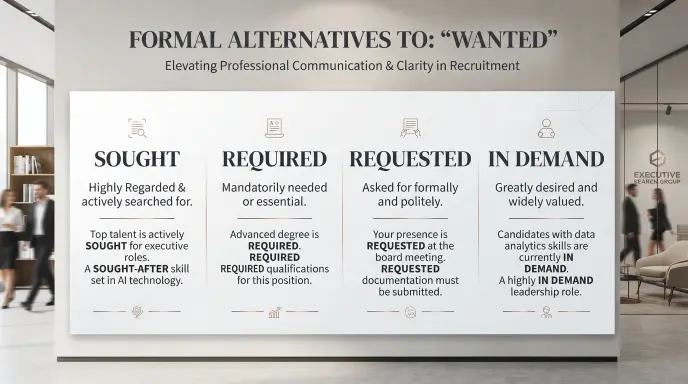
Desired
Meaning:
“Desired” means strongly wished for or wanted.
Explanation:
It is one of the closest formal alternatives to “wanted” when the meaning is personal preference or wish.
Example:
The applicant received the desired position.
Best Use:
Formal writing, reports, academic writing, and professional communication.
Worst Use:
Very casual conversation, where it may sound unnecessarily formal.
Tone:
Formal and polished.
Requested
Meaning:
“Requested” means asked for something, usually in a clear or polite way.
Explanation:
It should replace “wanted” only when someone actually made a request.
Example:
The customer requested a refund.
Best Use:
Business emails, customer service, workplace communication, and formal documents.
Worst Use:
Do not use it simply to describe a private desire.
Tone:
Polite and professional.
Sought
Meaning:
“Sought” means tried to find, obtain, or achieve something.
Explanation:
It is especially useful when “wanted” means actively looking for or pursuing something.
Example:
The company sought experienced employees.
Best Use:
Academic, professional, business, and formal writing.
Worst Use:
Simple casual conversations where “looked for” sounds more natural.
Tone:
Formal and concise.
Required
Meaning:
“Required” means needed because something is necessary.
Explanation:
It is not an exact synonym for every use of “wanted.” It works when “wanted” actually means “needed.”
Example:
All applicants were required to submit identification.
Best Use:
Instructions, policies, procedures, and formal communication.
Worst Use:
Personal preferences.
Tone:
Formal and authoritative.
Preferred
Meaning:
“Preferred” means liked or chosen over another option.
Explanation:
Use it when someone has a clear choice or preference.
Example:
The client preferred a morning appointment.
Best Use:
Business, surveys, forms, emails, and professional communication.
Worst Use:
Situations involving urgent needs rather than choices.
Tone:
Neutral to formal.
Intended
Meaning:
“Intended” means planned or meant for a particular purpose.
Explanation:
It can relate to “wanted” when the meaning involves someone’s plan or purpose, but it is not a direct synonym for desire.
Example:
The changes were intended to improve communication.
Best Use:
Academic and professional writing.
Worst Use:
Personal wishes where “desired” is more accurate.
Tone:
Formal and precise.
Pursued
Meaning:
“Pursued” means actively tried to achieve or obtain something.
Explanation:
It suggests effort and action, so it is stronger than simply “wanted.”
Example:
She pursued a career in engineering.
Best Use:
Goals, careers, opportunities, ambitions, and long-term plans.
Worst Use:
Simple preferences.
Tone:
Active and purposeful.
Coveted
Meaning:
“Coveted” means strongly desired, especially because something is valuable or attractive.
Explanation:
It carries a stronger emotional sense than ordinary “wanted.”
Example:
He won the coveted scholarship.
Best Use:
Achievements, awards, positions, prizes, and highly desirable objects.
Worst Use:
Ordinary everyday needs.
Tone:
Formal and expressive.
Sought-After
Meaning:
“Sought-after” describes something that many people want or value.
Explanation:
It usually describes a person, product, skill, place, or opportunity that is in high demand.
Example:
She is a sought-after speaker.
Best Use:
Business writing, marketing, careers, and professional profiles.
Worst Use:
A single person’s private desire.
Tone:
Professional and polished.
Wished For
Meaning:
“Wished for” means hoped or desired.
Explanation:
It focuses more on a person’s hope or desire than on a request.
Example:
The children finally received the gift they had wished for.
Best Use:
Personal writing, stories, and emotional contexts.
Worst Use:
Technical or highly formal documents.
Tone:
Warm and personal.
Longed For
Meaning:
“Longed for” means wanted something very strongly for a period of time.
Explanation:
It expresses deep emotional desire.
Example:
After years away, she longed for home.
Best Use:
Personal writing, storytelling, and emotional descriptions.
Worst Use:
Routine workplace communication.
Tone:
Emotional and expressive.
Semi-Formal and Neutral Alternatives
Needed
Meaning:
“Needed” means something was necessary.
Explanation:
This is only appropriate when “wanted” refers to necessity rather than preference.
Example:
We needed more time to finish the project.
Best Use:
Work, school, everyday communication, and practical situations.
Worst Use:
A simple personal preference.
Tone:
Neutral.
Asked For
Meaning:
“Asked for” means requested something.
Explanation:
It is a natural everyday alternative when someone verbally or in writing made a request.
Example:
She asked for an extra copy.
Best Use:
Conversation, emails, and everyday writing.
Worst Use:
Formal legal or academic writing where “requested” may be more suitable.
Tone:
Neutral and conversational.
Looked For
Meaning:
“Looked for” means searched for something.
Explanation:
Use it when “wanted” means someone was trying to find something.
Example:
I looked for my keys everywhere.
Best Use:
Everyday conversation and informal writing.
Worst Use:
Formal reports, where “sought” may be more precise.
Tone:
Casual and natural.
Hoped For
Meaning:
“Hoped for” means desired something that may or may not happen.
Explanation:
It emphasizes expectation or possibility rather than certainty.
Example:
They hoped for good results.
Best Use:
Personal writing, school assignments, and everyday communication.
Worst Use:
When the person has already made a firm decision or request.
Tone:
Neutral and slightly personal.
Chosen
Meaning:
“Chosen” means selected from available options.
Explanation:
It can replace “wanted” only when the sentence involves selecting something.
Example:
The team chose the blue design.
Best Use:
Decisions, selections, applications, and planning.
Worst Use:
A desire without an actual choice.
Tone:
Neutral.
Expected
Meaning:
“Expected” means believed or anticipated that something would happen.
Explanation:
It differs from “wanted” because expectation does not always mean desire.
Example:
We expected the package to arrive today.
Best Use:
Reports, updates, schedules, and predictions.
Worst Use:
Personal preferences.
Tone:
Neutral and professional.
Planned
Meaning:
“Planned” means intended to do something.
Explanation:
It indicates an intention or arrangement rather than simply wanting something.
Example:
We planned to visit the museum on Saturday.
Best Use:
Schedules, projects, travel, and everyday communication.
Worst Use:
Describing something someone merely wishes to have.
Tone:
Neutral.
Considered
Meaning:
“Considered” means thought about something as a possible choice.
Explanation:
It is weaker than “wanted.” Someone can consider something without actually wanting it.
Example:
The company considered several solutions.
Best Use:
Reports, business writing, academic work, and decision-making.
Worst Use:
When there is a definite desire.
Tone:
Neutral and analytical.
Was Interested In
Meaning:
“Was interested in” means wanted to learn about, explore, or possibly obtain something.
Explanation:
It is softer than “wanted” and often sounds more polite.
Example:
The customer was interested in our premium plan.
Best Use:
Customer service, sales conversations, emails, and casual communication.
Worst Use:
When the person has already made a firm request.
Tone:
Polite and neutral.
Informal and Casual Alternatives
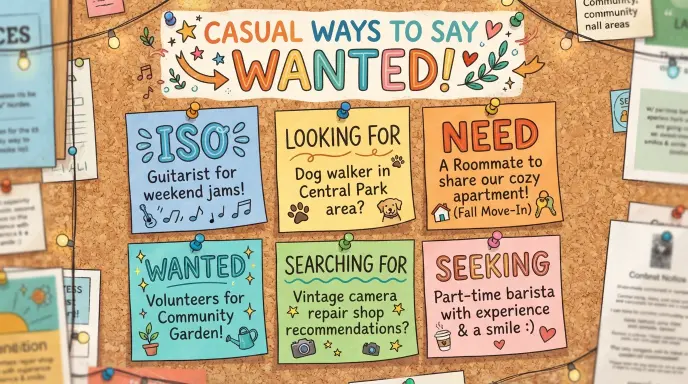
Really Wanted
Meaning:
“Really wanted” emphasizes strong desire.
Example:
I really wanted that book.
When It Sounds Natural:
Casual conversations, texts, and personal messages.
When to Avoid It:
Formal reports and academic writing.
Tone:
Casual and expressive.
Was After
Meaning:
“Was after” can mean wanted or was trying to obtain something.
Example:
I was after a quiet place to study.
When It Sounds Natural:
Informal conversation, especially in varieties of English where this expression is common.
When to Avoid It:
Formal business and academic writing.
Tone:
Informal.
Was Looking For
Meaning:
“Was looking for” means was trying to find something.
Example:
I was looking for a new backpack.
When It Sounds Natural:
Everyday conversation and messages.
When to Avoid It:
Formal documents when “sought” is more concise.
Tone:
Casual and natural.
Was Hoping For
Meaning:
“Was hoping for” expresses a polite or uncertain desire.
Example:
I was hoping for a quick answer.
When It Sounds Natural:
Friendly requests, emails, and conversations.
When to Avoid It:
Very formal documents when direct wording is needed.
Tone:
Polite and conversational.
Had a Craving For
Meaning:
“Had a craving for” means strongly wanted food or another sensory experience.
Example:
I had a craving for pizza.
When It Sounds Natural:
Casual conversation.
When to Avoid It:
Professional and academic writing.
Tone:
Very casual.
True Synonyms vs. Contextual Alternatives
Not every word connected to “wanted” can replace it in every sentence. The exact meaning matters. For example, desired is close to “wanted” when describing a wish, while requested refers to an actual request. Needed introduces necessity, and looked for introduces searching.
| Type | What It Means | Can It Replace the Original? |
|---|---|---|
| True synonym | Nearly the same basic meaning | Usually |
| Near synonym | Similar meaning with a small difference | Sometimes |
| Contextual alternative | Works in a specific situation | Only in that context |
| Broader expression | Covers a wider idea | Sometimes |
| Narrower expression | Gives a more specific meaning | Only when that detail is intended |
Business Writing
Business writing usually benefits from precise alternatives rather than vague repetition.
Professional Alternatives
Use desired for preferences, requested for formal asks, sought for goals or efforts, and required for necessities.
Example:
Instead of “The client wanted additional information,” write “The client requested additional information” if the client actually asked for it.
Example Sentences
- The client requested a revised proposal.
- The team sought additional feedback.
- The manager preferred the earlier design.
- The company required updated documentation.
- The customer desired a faster delivery option.
Corporate Communication
Reports and Policies
Corporate documents should distinguish between preferences, requirements, requests, and goals.
For example, “employees wanted flexible hours” is different from “employees requested flexible hours.” The second statement indicates an actual request.
Internal Communication
For workplace messages, requested, preferred, needed, and sought are often clearer than repeating “wanted.”
Professional Announcements
If describing demand, sought-after can be useful:
The training program provides sought-after technical skills.
Academic Writing
Formal Word Choices
Academic writing often benefits from words such as desired, sought, preferred, intended, and required.
Instead of:
The researchers wanted to understand the results.
You could write:
The researchers sought to understand the results.
The second version is more precise because it emphasizes an active research goal.
Essay Examples
- The study sought to examine the relationship between the variables.
- Participants preferred the second option.
- The researchers intended to compare the two groups.
- The experiment required additional testing.
Customer Service
Polite Alternatives
Customer service writing should be clear without sounding demanding.
Useful choices include:
- Requested
- Preferred
- Needed
- Was interested in
- Was hoping for
Customer-Friendly Examples
We understand that you were hoping for an earlier delivery date.
This sounds softer than:
We know you wanted an earlier delivery date.
Legal Writing
Legal Meaning of Wanted
“Wanted” can have a special meaning in legal or law-enforcement contexts, such as describing a person who is being sought by authorities. In that situation, replacing the word casually can change the meaning.
Choosing Precise Legal Language
Terms such as sought, required, or requested should be used only when they accurately describe the situation. Legal language often depends on precise wording, so a general synonym should not be substituted simply for variety.
Email Communication
Client Emails
Use requested when referring to something a client specifically asked for.
Internal Emails
Use needed for necessities and preferred for choices.
Requests and Follow-Ups
Was hoping for can make a request sound softer:
I was hoping for an update by Friday.
Email Examples
Client Communication Email
Subject: Requested Proposal Update
Hello Maria,
Thank you for your feedback. We have included the changes you requested and attached the revised proposal for your review.
Best,
Daniel
Project Update Email
Subject: Additional Information Needed
Hi Team,
We needed a few more details before finalizing the report, so the deadline has been moved to Thursday.
Thanks,
Ava
Request Email
Subject: Preferred Meeting Time
Hi James,
I preferred the Thursday afternoon option because it works best with my current schedule. Please let me know if that time is still available.
Best,
Sam
Meeting Email
Subject: Meeting Follow-Up
Hello everyone,
We hoped for a quick discussion about the upcoming changes, so I have scheduled a short meeting for Tuesday.
Regards,
Nina
Customer Service Email
Subject: Your Delivery Request
Hello,
We understand that you were hoping for an earlier delivery. We are checking the available options and will update you shortly.
Best,
Customer Support
Academic Email
Subject: Research Question
Dear Professor Lee,
I sought additional guidance on the research method before completing the assignment. Could you please clarify the recommended approach?
Sincerely,
Alex
Internal Workplace Email
Subject: Design Preference
Hi Team,
The client preferred the second design during today’s review. Please use that version for the next revision.
Thanks,
Maya
Vendor Email
Subject: Requested Documents
Hello,
We have received the documents you sent. Our team will review the information and contact you if anything else is required.
Regards,
Omar
Short Dialogue Examples
Workplace Conversation
Person A: What did the client want changed?
Person B: They requested a simpler layout.
Classroom Conversation
Person A: What did the researchers want to discover?
Person B: They sought to understand how the two methods compared.
Customer Service Conversation
Person A: What does the customer want?
Person B: They are looking for a replacement.
Casual Conversation
Person A: What did you want for lunch?
Person B: I was hoping for pizza.
Professional Discussion
Person A: Which option did the manager want?
Person B: She preferred the second option.
How to Replace “Wanted” in a Sentence
Example 1: Wanted → Desired
Original:
The customer wanted a faster service.
Alternative:
The customer desired faster service.
Why it works:
“Desired” preserves the meaning of wanting, but it sounds more formal.
Example 2: Wanted → Requested
Original:
The client wanted a copy of the report.
Alternative:
The client requested a copy of the report.
Why it works:
“Requested” is better if the client actually asked for the report.
Example 3: Wanted → Needed
Original:
We wanted more time to finish the task.
Alternative:
We needed more time to finish the task.
Why it works:
The alternative changes the meaning from preference to necessity.
Example 4: Wanted → Preferred
Original:
She wanted the blue option.
Alternative:
She preferred the blue option.
Why it works:
“Preferred” suggests that she chose the blue option over another choice.
Example 5: Wanted → Sought
Original:
The company wanted experienced workers.
Alternative:
The company sought experienced workers.
Why it works:
“Sought” sounds professional and suggests an active search or effort.
Example 6: Wanted → Looked For
Original:
He wanted his missing notebook.
Alternative:
He looked for his missing notebook.
Why it works:
The meaning changes from desire to actively searching for something.
Example 7: Wanted → Hoped For
Original:
They wanted good results.
Alternative:
They hoped for good results.
Why it works:
“Hoped for” emphasizes uncertainty about the outcome.
Example 8: Wanted → Required
Original:
The form wanted additional information.
Alternative:
The form required additional information.
Why it works:
“Required” is more accurate when the information is necessary rather than desired.
Comparison of the Best Alternatives
| Phrase | Tone | Meaning / Scope | Best Use | Example |
|---|---|---|---|---|
| Desired | Formal | Strongly wanted | Formal writing | The desired result |
| Requested | Professional | Asked for | Business emails | She requested a copy |
| Sought | Formal | Tried to find or achieve | Academic/business writing | They sought advice |
| Needed | Neutral | Necessary | Everyday/work | We needed help |
| Preferred | Neutral/Formal | Chose one option | Business/choices | He preferred tea |
| Hoped for | Neutral | Desired an uncertain result | Conversation/writing | She hoped for good news |
| Looked for | Casual | Tried to find | Everyday speech | I looked for my keys |
| Pursued | Formal | Actively tried to achieve | Goals/careers | He pursued the opportunity |
| Coveted | Formal | Strongly desired | Awards/positions | A coveted award |
| Required | Formal | Necessary | Policies/instructions | Documents are required |
Which Alternative Should You Choose?
Best for Formal Writing
Choose desired, sought, preferred, or intended depending on the meaning.
Best for Business Communication
Use requested when someone asked for something, preferred for choices, and required for necessities.
Best for Academic Writing
Sought is particularly useful for describing research aims.
Best for Legal Writing
Choose the most precise term rather than changing words merely for variety. Requested, required, and sought have different meanings.
Best for Professional Emails
Requested, preferred, and was hoping for are useful because they can sound clear without being unnecessarily blunt.
Best for Everyday Conversation
Use wanted, needed, asked for, looked for, and was hoping for.
Best for Casual Messages
Natural expressions such as really wanted, was looking for, and was hoping for work well.
Grammar and Usage Guide
Wanted as a Verb
“Wanted” is the past tense and past participle of want.
Example:
I wanted a new notebook.
Wanted as an Adjective
“Wanted” can also describe something that is desired or sought.
Example:
The job requires several highly wanted skills.
However, in many contexts, desired or sought-after may sound more natural.
Wanted in the Past Tense
Use “wanted” when describing a past desire or intention.
Example:
She wanted to study abroad.
Wanted + Infinitive
A common structure is:
wanted + to + verb
Example:
They wanted to leave early.
Possible alternatives include:
They hoped to leave early.
They intended to leave early.
The meaning changes slightly with each choice.
Wanted + Object
Another common structure is:
wanted + noun/object
Example:
He wanted a new phone.
Depending on the meaning:
He desired a new phone.
Meanwhile, he preferred the latest model. In addition, he requested a replacement device.
Each alternative adds a different shade of meaning.
Common Word Combinations
Common expressions include:
- wanted to know
- wanted to ask
- wanted to see
- wanted to learn
- wanted to find
- wanted to buy
- wanted to become
- wanted to improve
The best synonym depends on the verb that follows.
Common Mistakes to Avoid
Treating Every Alternative as an Exact Synonym
“Wanted” and “needed” are not interchangeable. One describes desire; the other describes necessity.
Using the Wrong Tone
Words such as coveted may sound too dramatic for simple everyday situations.
Changing the Intended Meaning
Replacing “wanted” with “requested” suggests an actual request.
Using Overly Formal Language
“Desired” may sound stiff in a casual text where “wanted” is perfectly natural.
Using Casual Language in Professional Writing
Expressions such as “was after” may be inappropriate in formal business documents.
Using Vague Alternatives
“Was interested in” can be weaker than “requested” when a customer has already made a definite request.
Ignoring Context
Always ask what “wanted” means in the sentence: desire, request, need, search, preference, or intention.
Replacing Words Just for Variety
A synonym is not automatically better. If “wanted” is the clearest word, keep it.
When Not to Use “Wanted”
When the Meaning Is a Formal Request
Use requested when someone officially asks for something.
When Something Is Necessary
Use needed or required when the situation involves necessity.
When Someone Is Searching
Use sought or looked for when the person is actively trying to find something.
When You Need a More Formal Tone
In reports or academic writing, desired or sought may sometimes be more suitable.
When the Choice Matters
Use preferred when someone selects one option over another.
When the Meaning Is Uncertain
Use hoped for if someone desired an outcome but did not know whether it would happen.
When “Wanted” Is Actually the Better Choice
Do not replace a simple, clear word just because you want variety. In everyday English, “wanted” is natural, familiar, and often the strongest choice.
Advanced Writer Tips
Tone Control
Choose desired or sought for a more formal tone. Use wanted or looked for for everyday communication.
Professional Email Etiquette
Use precise verbs. “Requested” is better than “wanted” when describing a specific request because it tells the reader exactly what happened.
Politeness
“Was hoping for” can soften a request:
I was hoping for an update.
This often sounds less demanding than:
I wanted an update.
Context Alignment
Think about the purpose before choosing a synonym. A research paper, customer email, text message, and legal document may need completely different wording.
Precision
Ask whether the person desired, requested, needed, preferred, or searched for something. The most precise word is usually better than the most sophisticated word.
Readability
Short, familiar words often improve readability. Do not replace “wanted” with a complex expression if the simpler word communicates the idea perfectly.
Related Questions
What Is Another Way to Say Wanted?
Depending on the meaning, you can say desired, requested, needed, preferred, sought, hoped for, looked for, or pursued.
What Is a Professional Alternative to Wanted?
Requested, sought, preferred, desired, and required are useful professional alternatives, but each has a different meaning.
What Is a Formal Alternative to Wanted?
Desired is one of the closest formal alternatives. Sought is also useful when the meaning involves searching for or pursuing something.
What Can I Use Instead of Wanted?
Choose the word based on the intended meaning. Use requested for an actual request, needed for necessity, preferred for a choice, and looked for for searching.
Is Wanted a Formal Word?
“Wanted” is neutral and widely accepted in both spoken and written English. It is not inherently informal.
Can Desired Replace Wanted?
Often, yes, when “wanted” means strongly wished for. However, “desired” can sound more formal and may not fit every casual sentence.
What Is the Difference Between Wanted and Desired?
Both can describe a wish, but desired is generally more formal and can sound more deliberate. “Wanted” is broader and more common in everyday English.
FAQs
What Is the Closest Synonym for Wanted?
Desired is often the closest synonym when “wanted” means wished for or strongly preferred. However, there is no single replacement that works in every sentence because “wanted” can also mean requested, needed, or searched for.
What Is a Formal Synonym for Wanted?
Desired and sought are strong formal alternatives. “Desired” focuses on a wish or preference, while “sought” suggests an active attempt to find, obtain, or achieve something.
What Is a Professional Alternative to Wanted?
Requested is a strong professional choice when someone asked for something. Preferred works for choices, while required works when something is necessary.
Is Desired the Same as Wanted?
They are very close when both describe a wish. The main difference is tone: “desired” is more formal, while “wanted” is more common and natural in everyday English.
What Is a Casual Way to Say Wanted?
In casual English, you can use really wanted, was looking for, was hoping for, or was after, depending on the intended meaning.
Can Needed Replace Wanted?
Only when “wanted” means something was necessary. For example, “We wanted more time” does not always mean “We needed more time.” The second sentence says that more time was necessary.
Which Alternative Is Best for Academic Writing?
Sought is often useful for research aims, while desired, preferred, intended, and required work in other academic contexts. The correct choice depends on the exact meaning.
Key Takeaways
- Desired is one of the closest formal alternatives to “wanted” when describing a wish.
- Use requested when someone actually asks for something.
- Use needed or required when something is necessary.
- Use sought or looked for when the meaning involves searching or pursuing.
- Always choose the alternative based on meaning, tone, audience, and context.
Conclusion
“Wanted” is a simple and flexible English word, but its best synonym depends heavily on what you mean. If you are talking about a desire, desired is often the closest formal alternative. If someone made a request, requested is more precise. For necessity, choose needed or required.
For searching or pursuing something, sought or looked for may be better. Other options, such as preferred, hoped for, pursued, coveted, and intended, add more specific shades of meaning.
The key is not to replace “wanted” automatically. First identify the idea behind the word, then choose the alternative that communicates that idea most accurately.
In casual conversation, “wanted” is often the clearest choice. In professional, academic, or formal writing, a more precise alternative can make the sentence stronger, clearer, and better suited to its audience.
