
Finding the right synonym for initiative can make your writing clearer, more professional, and more precise. The word initiative can describe a new plan, a first step, or the ability to act without being told what to do.
Because it has several meanings, the best replacement depends on the sentence and context.
For example, initiative in “She showed initiative at work” refers to self-motivation and independent action. But in “The company launched a recycling initiative,” it refers to a planned project or program.
Using independence in the second sentence would not work. This guide explains more than 35 useful alternatives, including formal, neutral, casual, business, academic, and contextual choices.
Quick Answer
Useful synonyms for initiative include enterprise, drive, ambition, self-motivation, leadership, action, effort, undertaking, plan, program, project, campaign, measure, proposal, strategy, approach, endeavor, venture, movement, innovation, first step, opening move, and proactive action. The best choice depends on whether initiative means independent action, a new project, or the first step in a process.
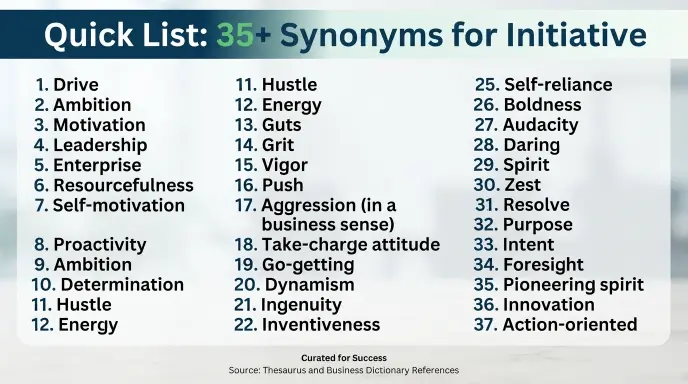
Quick List: 35+ Synonyms for Initiative
Closest or Near Synonyms
- Enterprise
- Drive
- Ambition
- Self-motivation
- Proactivity
- Leadership
- Enterprise
- Resourcefulness
- Ingenuity
- Independence
- Determination
- Willingness to act
Alternatives for a Project or Program
- Project
- Program
- Campaign
- Plan
- Proposal
- Undertaking
- Endeavor
- Venture
- Scheme
- Measure
- Strategy
- Effort
- Movement
- Action
- Course of action
Alternatives for a First Step
- First step
- Opening move
- Start
- Beginning
- Lead
- Opening
- Launch
- Kickoff
- Move
- Advance
More Contextual Alternatives
- Innovation
- Intervention
- Reform
- Approach
- Solution
- Commitment
- Contribution
- Leadership effort
Not all of these are exact synonyms. Some replace initiative only in particular contexts, which is why the distinctions below matter.
Formal Alternatives to Initiative
1. Enterprise
Meaning: A purposeful activity or undertaking, often involving effort, organization, or risk.
Explanation: Enterprise is a strong alternative when initiative means an ambitious project or organized effort. It does not always mean personal motivation.
Example: The new environmental enterprise brought several community groups together.
Best Use: Business writing, formal reports, entrepreneurship, and descriptions of ambitious projects.
Worst Use: Simple everyday situations where effort or action would sound more natural.
Tone: Formal and purposeful.
2. Endeavor
Meaning: A serious attempt or effort to achieve something.
Explanation: Endeavor emphasizes the effort involved rather than the independent decision to begin.
Example: The university’s latest endeavor focuses on improving student access to technology.
Best Use: Formal writing, academic work, reports, and professional communication.
Worst Use: Casual conversation, where it can sound unnecessarily formal.
Tone: Formal and serious.
3. Undertaking
Meaning: A task, project, or responsibility that requires effort.
Explanation: An undertaking can be an initiative when you are referring to a specific organized activity.
Example: The restoration project was a major undertaking for the local council.
Best Use: Reports, business documents, and formal descriptions of projects.
Worst Use: When you mean someone’s willingness to act independently.
Tone: Formal and professional.
4. Proactivity
Meaning: The habit of taking action before a problem or need becomes urgent.
Explanation: This is closely related to the personal-quality meaning of initiative. It focuses strongly on acting in advance.
Example: Her proactivity helped the team identify potential problems early.
Best Use: Workplace reviews, leadership discussions, business writing, and professional development.
Worst Use: Referring to a named government or company program.
Tone: Professional.
5. Resourcefulness
Meaning: The ability to find practical ways to solve problems.
Explanation: Resourcefulness overlaps with initiative because both can involve independent action. However, resourcefulness emphasizes solving problems with available resources.
Example: His resourcefulness allowed the team to finish the project despite limited equipment.
Best Use: Performance reviews, education, leadership, and problem-solving contexts.
Worst Use: Describing a formal program or campaign.
Tone: Positive and professional.
6. Innovation
Meaning: A new idea, method, product, or approach.
Explanation: Innovation can be an initiative when the initiative introduces something genuinely new. The words are not interchangeable in every sentence.
Example: The company’s latest innovation reduced unnecessary packaging.
Best Use: Technology, business, science, product development, and organizational change.
Worst Use: When simply describing someone’s willingness to take action.
Tone: Modern and professional.
7. Venture
Meaning: A new activity or project that may involve risk or uncertainty.
Explanation: Venture works when an initiative involves entering a new area or taking a calculated risk.
Example: The partnership is a promising venture for both organizations.
Best Use: Business, entrepreneurship, investment, and new projects.
Worst Use: Ordinary tasks with no meaningful element of risk.
Tone: Professional and ambitious.
8. Proposal
Meaning: A suggested plan or course of action.
Explanation: A proposal may lead to an initiative, but it is usually the suggestion rather than the action itself.
Example: She submitted a proposal for a campus recycling program.
Best Use: Academic, business, government, and organizational writing.
Worst Use: Replacing initiative when the action has already begun.
Tone: Formal and precise.
9. Measure
Meaning: An action taken to achieve a particular purpose.
Explanation: Measure is useful in formal writing when an initiative is a specific action designed to address an issue.
Example: The school introduced new measures to improve student safety.
Best Use: Policies, reports, public administration, and formal announcements.
Worst Use: Informal conversations.
Tone: Formal and administrative.
10. Strategy
Meaning: A planned approach for achieving a goal.
Explanation: A strategy is broader and more deliberate than an initiative. An initiative can be one part of a larger strategy.
Example: The company developed a strategy for reducing energy use.
Best Use: Business, management, marketing, and organizational planning.
Worst Use: Referring to a person’s spontaneous willingness to act.
Tone: Professional and analytical.
11. Course of Action
Meaning: A planned way of responding to a situation.
Explanation: This phrase is useful when initiative means a specific action or plan.
Example: The committee agreed on a new course of action.
Best Use: Professional reports, meetings, planning, and formal discussions.
Worst Use: Casual messages, where it may sound stiff.
Tone: Formal and neutral.
12. Movement
Meaning: An organized effort by people working toward a shared goal.
Explanation: Movement is appropriate when an initiative becomes a broader social or public effort.
Example: The campaign became part of a larger environmental movement.
Best Use: Social change, public issues, activism, and community efforts.
Worst Use: Small workplace tasks.
Tone: Formal to neutral.
Semi-Formal and Neutral Alternatives
13. Project
Meaning: A planned piece of work with a particular goal.
Explanation: Project is one of the most useful replacements when initiative refers to something organized and concrete.
Example: The company launched a project to improve customer support.
Best Use: Work, school, business, websites, and everyday professional writing.
Worst Use: Describing personal self-motivation.
Tone: Neutral and professional.
14. Program
Meaning: An organized set of activities designed to achieve a goal.
Explanation: A program is usually larger or more structured than a single initiative.
Example: The university introduced a mentoring program for new students.
Best Use: Education, government, business, health, and community organizations.
Worst Use: A single spontaneous action.
Tone: Neutral and professional.
15. Campaign
Meaning: An organized effort to achieve a particular result.
Explanation: Campaign works especially well for public awareness, marketing, political, fundraising, and social efforts.
Example: The charity started a campaign to collect school supplies.
Best Use: Marketing, fundraising, awareness, and public communication.
Worst Use: A small internal workplace action.
Tone: Active and purposeful.
16. Plan
Meaning: A set of intended actions for achieving a goal.
Explanation: A plan focuses on what someone intends to do. An initiative may include the plan plus its implementation.
Example: The team created a plan to reduce project delays.
Best Use: Everyday writing, work, school, and planning.
Worst Use: When you want to emphasize independent action rather than preparation.
Tone: Neutral.
17. Effort
Meaning: An attempt or amount of work made toward a goal.
Explanation: Effort is broader than initiative. It describes work or attempts, not necessarily independent action.
Example: The team’s effort helped improve the service.
Best Use: Everyday writing, school, work, and general descriptions.
Worst Use: A formal name for a major program.
Tone: Neutral and natural.
18. Action
Meaning: Something done to achieve a result.
Explanation: Action is useful when the focus is on doing something rather than merely suggesting it.
Example: The new safety action addressed several concerns raised by employees.
Best Use: General writing and situations emphasizing implementation.
Worst Use: When the original sentence specifically refers to an organized program.
Tone: Direct and neutral.
19. Approach
Meaning: A particular way of dealing with a problem or situation.
Explanation: An approach describes how something is handled rather than the initiative itself.
Example: The company adopted a new approach to employee training.
Best Use: Business, education, problem-solving, and professional communication.
Worst Use: A named campaign or project.
Tone: Neutral and analytical.
20. Contribution
Meaning: Something given or done to help achieve a result.
Explanation: This works when initiative refers to someone’s positive input, but it does not necessarily suggest that the person acted independently.
Example: Her contribution helped the team complete the assignment.
Best Use: Performance reviews, teamwork, school, and professional writing.
Worst Use: Describing a new company program.
Tone: Positive and neutral.
21. Drive
Meaning: Strong energy and determination to achieve something.
Explanation: Drive is a good alternative when initiative refers to motivation and determination.
Example: His drive helped the team meet the deadline.
Best Use: Performance reviews, leadership, careers, and personal development.
Worst Use: Formal descriptions of government programs.
Tone: Positive and energetic.
22. Ambition
Meaning: A strong desire to achieve something.
Explanation: Ambition is related to initiative but focuses on goals and aspirations rather than action itself.
Example: Her ambition motivated her to take on challenging projects.
Best Use: Careers, education, leadership, and personal development.
Worst Use: Replacing initiative for an actual project or program.
Tone: Positive and professional.
23. Self-Motivation
Meaning: The ability to motivate yourself without needing someone else to push you.
Explanation: This is one of the closest choices when initiative describes a person’s independent work habits.
Example: The role requires strong self-motivation and good organizational skills.
Best Use: Resumes, interviews, job descriptions, and performance reviews.
Worst Use: Naming a public program.
Tone: Professional.
24. Independence
Meaning: The ability to act or make decisions without relying heavily on others.
Explanation: Independence overlaps with initiative but emphasizes autonomy.
Example: The position gives students greater independence in managing their research.
Best Use: Education, employment, leadership, and personal development.
Worst Use: When the key idea is taking the first action.
Tone: Neutral and professional.
25. Determination
Meaning: Firmness and persistence in pursuing a goal.
Explanation: Determination is related to initiative but emphasizes persistence rather than starting action.
Example: Her determination helped the team overcome several setbacks.
Best Use: Personal qualities, professional writing, education, and encouragement.
Worst Use: A formal name for an organized project.
Tone: Positive and strong.
Informal and Casual Alternatives
There are fewer true casual synonyms for initiative. In everyday speech, people often replace it with simpler expressions rather than a single synonym.
26. Get-Up-and-Go
Meaning: Energy and willingness to take action.
Example: Maya has plenty of get-up-and-go and rarely waits for someone to tell her what to do.
When it sounds natural: Friendly conversation and informal writing.
When to avoid it: Resumes, academic papers, formal reports, and serious business communication.
Tone: Casual and upbeat.
27. Go-Getter Attitude
Meaning: A strong willingness to work hard and pursue goals.
Example: The manager liked his go-getter attitude.
When it sounds natural: Informal workplace conversations and personal descriptions.
When to avoid it: Formal academic writing.
Tone: Casual and positive.
28. Taking the Lead
Meaning: Choosing to become the person who starts or guides an activity.
Example: Sara took the lead when the group needed someone to organize the event.
When it sounds natural: Work, school, and everyday conversation.
When to avoid it: When the person acted independently but did not actually lead others.
Tone: Neutral to conversational.
29. Making the First Move
Meaning: Taking the first action in a situation.
Example: He made the first move and contacted the supplier.
When it sounds natural: Conversation, negotiations, and informal professional settings.
When to avoid it: Formal reports unless the wording fits the context.
Tone: Conversational.
30. Stepping Up
Meaning: Volunteering to take responsibility or help when needed.
Example: Priya stepped up when the team needed someone to manage the presentation.
When it sounds natural: Workplace conversations, sports, school, and casual communication.
When to avoid it: Highly formal academic writing.
Tone: Conversational and positive.
True Synonyms vs. Contextual Alternatives

The most important point is that initiative has more than one meaning. A synonym that works in one sentence may be wrong in another.
| Type | What It Means | Can It Replace the Original? |
|---|---|---|
| True or very close synonym | A word with nearly the same meaning in the specific context | Usually |
| Near synonym | Similar idea but with a different emphasis | Sometimes |
| Contextual alternative | Works only in a particular situation | Only in that context |
| Broader expression | Covers a larger or less specific idea | Sometimes |
| Narrower expression | Describes one specific aspect of initiative | Only when that aspect is intended |
For example, self-motivation can replace initiative in “She showed initiative at work,” but it cannot replace initiative in “The company launched a new health initiative.”
Likewise, project can replace initiative when the word refers to an organized activity, but it cannot describe someone’s willingness to act independently.
Initiative in Business Writing
Business writing often uses initiative to describe a new program, project, or action.
Good alternatives include:
- Project
- Program
- Strategy
- Campaign
- Measure
- Undertaking
- Approach
- Effort
- Proposal
- Action
Example:
Original: The company launched an employee wellness initiative.
Alternative: The company launched an employee wellness program.
Here, program is more precise because the activity has an organized structure.
For personal qualities:
Original: Daniel showed initiative during the project.
Alternative: Daniel showed strong self-motivation during the project.
The second sentence focuses more clearly on Daniel’s independent motivation.
Corporate Communication
In reports and internal announcements, choose the word that tells readers exactly what is happening.
Initiative works well for a new organized effort:
The company has introduced a sustainability initiative.
Program works when the effort has a structured set of activities:
The company has introduced a sustainability program.
Strategy works when the focus is on a long-term plan:
The company has adopted a sustainability strategy.
Measure works when the focus is on a specific action:
The company has introduced new sustainability measures.
These words are related, but they are not interchangeable in every sentence.
Academic Writing
Academic writing usually benefits from precise alternatives.
Useful choices include:
- Approach
- Strategy
- Proposal
- Effort
- Undertaking
- Project
- Intervention
- Action
- Movement
- Program
Example:
Instead of:
The researchers developed an initiative to improve literacy.
You might write:
The researchers developed a program to improve literacy.
Or:
The researchers proposed an intervention to improve literacy.
Intervention is narrower because it usually means an intentional action designed to change an existing situation.
Customer Service
In customer service, simpler words are usually clearer.
Instead of:
We appreciate your initiative in contacting our support team.
A natural alternative might be:
We appreciate your effort to contact our support team.
For a company program:
We recently launched a new customer support program.
Avoid unnecessarily formal words such as undertaking when speaking directly with customers.
Legal Writing
Legal documents require special care because seemingly similar words can have different scopes.
Words such as measure, action, proposal, undertaking, program, and plan may be appropriate in particular contexts, but they should not automatically replace initiative.
For example:
The agency introduced a new initiative.
does not necessarily have the same meaning as:
The agency introduced a new legal measure.
A measure can imply a specific official action. In legal or regulatory writing, use the terminology established by the relevant document or governing authority rather than choosing a synonym simply for variety.
Email Communication
Professional emails benefit from precise, plain language.
You might use:
- Project for organized work
- Proposal for a suggested idea
- Plan for intended action
- Effort for work already performed
- Approach for a method
- Program for structured activities
- Action for something being done
- Self-motivation for a personal quality
For example:
I wanted to share our new customer feedback project.
is clearer than replacing initiative with a more formal word such as undertaking.
8 Email Examples Using Alternatives
1. Client Communication — Project
Subject: New Customer Feedback Project
Hi Jordan,
I wanted to let you know that we have started a new customer feedback project. The goal is to collect clearer feedback after each support interaction and use it to improve our service.
We would appreciate your thoughts on the first phase of the project.
Best,
Megan
2. Internal Workplace Email — Approach
Subject: A New Approach to Team Meetings
Hi Team,
Starting next week, we will try a new approach to our weekly meetings. We will send the main discussion points in advance so everyone has time to review them.
The goal is to keep meetings focused and leave more time for project work.
Thanks,
Alex
3. Proposal Request
Subject: Proposal for the Training Program
Hi Daniel,
Thank you for discussing the training needs with us. Could you please send your proposal by Friday?
We would especially like to see the suggested schedule, learning goals, and estimated cost.
Best regards,
Nina
4. Customer Service — Program
Subject: New Customer Support Program
Hello Mr. Lee,
We are pleased to let you know about our new customer support program. It provides additional help for customers who need assistance with account setup.
Please contact our support team if you would like more information.
Kind regards,
Customer Support Team
5. Academic Communication — Project
Subject: Research Project Update
Dear Professor Smith,
I am writing to share a brief update on my research project. I have completed the initial literature review and am now organizing the findings.
Best,
Emma
6. Vendor Communication — Course of Action
Subject: Next Course of Action
Hello Mark,
Thank you for the update. Based on the information you provided, I believe our next course of action should be to review the delivery schedule together.
Please let me know which day works best for a short call.
Regards,
Chris
7. Performance Discussion — Self-Motivation
Subject: Performance Review Feedback
Hi Olivia,
I wanted to recognize the self-motivation you have shown during the recent project. You regularly identified tasks that needed attention and handled them without waiting for instructions.
That independent approach made a real difference to the team.
Best,
Rachel
Short Dialogue Examples
Workplace
Person A: Who organized the client presentation?
Person B: Mia took the lead. She noticed we needed someone to coordinate everything and stepped up.
Classroom
Person A: Did the teacher assign you the research topic?
Person B: No. I proposed the project myself because I wanted to explore the subject.
Customer Service
Person A: What is this new program about?
Person B: It gives customers more support during account setup.
Casual Conversation
Person A: How did you get everyone involved?
Person B: I just made the first move and asked everyone to join.
Professional Discussion
Person A: Should we call this a project or an initiative?
Person B: I would use “project” because we already have a defined timeline, budget, and deliverables.
How to Replace “Initiative” in a Sentence
Example 1
Original:
She showed initiative by organizing the event.
Alternative:
She showed leadership by organizing the event.
Why it works:
The new version emphasizes her role in guiding the activity rather than simply acting independently.
Example 2
Original:
The company launched a new health initiative.
Alternative:
The company launched a new health program.
Why it works:
Program suggests a structured set of activities.
Example 3
Original:
He demonstrated initiative at work.
Alternative:
He demonstrated self-motivation at work.
Why it works:
The alternative focuses on his ability to work independently.
Example 4
Original:
The government introduced a new environmental initiative.
Alternative:
The government introduced new environmental measures.
Why it works:
Measures emphasizes specific actions.
Example 5
Original:
The team proposed a new initiative.
Alternative:
The team proposed a new plan.
Why it works:
Plan is simpler and focuses on intended actions.
Example 6
Original:
Her initiative helped solve the problem.
Alternative:
Her resourcefulness helped solve the problem.
Why it works:
The alternative highlights her ability to find a practical solution.
Example 7
Original:
The organization launched an educational initiative.
Alternative:
The organization launched an educational campaign.
Why it works:
Campaign works if the effort involves organized public promotion or awareness.
Example 8
Original:
His initiative impressed the manager.
Alternative:
His proactivity impressed the manager.
Why it works:
Proactivity emphasizes acting before being asked or before problems arise.
Example 9
Original:
The university’s new initiative supports first-year students.
Alternative:
The university’s new program supports first-year students.
Why it works:
Program is more precise if the support consists of organized services or activities.
Example 10
Original:
She took the initiative to contact the client.
Alternative:
She made the first move and contacted the client.
Why it works:
The alternative is more conversational and clearly emphasizes taking the first action.
Comparison Table
| Phrase | Tone | Meaning / Scope | Best Use | Example |
|---|---|---|---|---|
| Initiative | Neutral/professional | Independent action or organized effort | General professional writing | She took the initiative. |
| Proactivity | Professional | Acting before being asked | Work and performance reviews | His proactivity was valuable. |
| Self-motivation | Professional | Ability to motivate yourself | Careers and reviews | The role requires self-motivation. |
| Project | Neutral | Defined piece of work | Work and school | We started a new project. |
| Program | Neutral/professional | Structured set of activities | Organizations and education | The school launched a program. |
| Campaign | Active | Organized effort toward a goal | Marketing and awareness | They launched a campaign. |
| Strategy | Professional | Planned approach | Business and management | We need a new strategy. |
| Proposal | Formal | Suggested plan | Business and academic work | She submitted a proposal. |
| Effort | Neutral | Work or attempt | General communication | Their effort paid off. |
| Approach | Neutral | Way of handling something | Work and academic writing | We tried a different approach. |
| Drive | Positive | Energy and determination | Careers and leadership | Her drive is impressive. |
| Resourcefulness | Professional | Ability to solve problems | Work and education | His resourcefulness helped. |
| Enterprise | Formal | Ambitious undertaking | Business and formal writing | The enterprise expanded rapidly. |
| Endeavor | Formal | Serious effort or attempt | Reports and academic writing | The endeavor required patience. |
| First step | Casual/neutral | Beginning action | Everyday communication | This is the first step. |
Which Alternative Should You Choose?
For Formal Writing
Choose endeavor, undertaking, enterprise, measure, or course of action when the context genuinely calls for formal language.
For Business Communication
Use project, program, strategy, approach, proposal, or initiative. These words are familiar and precise in professional settings.
For Academic Writing
Prefer project, proposal, approach, endeavor, intervention, strategy, or effort, depending on the meaning.
For Legal Writing
Use the exact term required by the document or legal context. Measure, action, proposal, and undertaking can carry different meanings, so do not substitute them casually.
For Professional Emails
Use project, plan, program, approach, proposal, or action. Plain language usually sounds more confident and natural.
For Everyday Conversation
Use effort, first step, taking the lead, making the first move, or stepping up when they accurately express the intended idea.
For Casual Messages
Stepping up, making the first move, and go-getter attitude can work when the situation is informal.
Grammar and Usage Guide
1. “Take the initiative”
The most common expression is:
She took the initiative to contact the customer.
Not:
She took an initiative to contact the customer.
When referring to initiative as a general quality or willingness to act, take the initiative is especially natural.
2. “Show initiative”
Another common construction is:
Employees who show initiative often identify problems early.
Here, initiative is usually treated as an uncountable quality.
3. “An initiative”
Use the article an when initiative means a specific project, program, or organized effort.
The school launched an initiative to reduce waste.
4. “Initiatives”
Use the plural when discussing multiple organized efforts.
The organization introduced several community initiatives.
5. Common Prepositions
Natural combinations include:
- take the initiative to do something
- take the initiative in doing something
- launch an initiative to achieve a goal
- introduce an initiative for a particular purpose
- show initiative at work
Examples:
She took the initiative to arrange the meeting.
He took the initiative in contacting the supplier.
6. Capitalization
Usually, initiative is lowercase.
The company launched a new employee wellness initiative.
Capitalize it only when it forms part of an official name or title.
7. “Initiative” vs. “Initiatives”
Use singular initiative for one quality or one organized effort. Use initiatives for multiple projects or programs.
Common Mistakes to Avoid
1. Treating every synonym as interchangeable
Project, self-motivation, and campaign do not mean exactly the same thing.
2. Using “program” for personal behavior
You cannot normally replace “She showed initiative” with “She showed program.”
3. Using overly formal words
Endeavor may sound unnatural in a casual conversation.
4. Confusing initiative with ambition
Ambition describes the desire to achieve something. Initiative describes taking action independently.
5. Confusing initiative with strategy
A strategy is a planned approach. An initiative may be one action within that strategy.
6. Using casual phrases in formal writing
“Stepping up” sounds natural in conversation but may be too informal for an academic paper.
7. Changing the meaning accidentally
Replacing initiative with leadership suggests that someone guided other people, which may not have been true.
8. Using vague alternatives
Words such as thing, idea, or stuff remove useful information instead of improving the sentence.
9. Replacing a clear word just for variety
If initiative is already the most accurate word, keep it. Good writing values precision more than unnecessary synonym changes.
When Not to Use “Initiative”
You may want a different word when:
- The meaning is specifically a project. Use project or program.
- The meaning is personal motivation. Use self-motivation or drive.
- The meaning is a suggested plan. Use proposal.
- The meaning is a specific official action. Measure may be more precise.
- The meaning is a method. Use approach or strategy.
- The setting is very casual. Use first move or stepping up if appropriate.
- The sentence emphasizes solving problems. Resourcefulness may be clearer.
- The word already appears repeatedly. A precise alternative can improve readability.
However, do not avoid initiative simply because you want to sound sophisticated. In many professional sentences, it is the clearest and most natural choice.
Advanced Writer Tips
Tone Control
Choose the word that matches your audience. Self-motivation sounds professional, while get-up-and-go sounds playful.
Professional Email Etiquette
Prefer simple terms such as project, plan, proposal, and approach. Clear wording often sounds more professional than complicated vocabulary.
Politeness
Word choice can change how direct a sentence feels.
Please send your proposal by Friday.
is direct and professional.
Could you please send your proposal by Friday?
is softer and more polite.
Context Alignment
Ask what initiative actually means in the sentence. Is it a person’s behavior, a project, a plan, a first action, or an organized campaign? Choose the synonym based on that meaning.
Precision
A strong synonym should preserve the important part of the original meaning. If initiative means independent action, self-motivation may work. If it means a public program, campaign or program may be better.
Readability
Do not replace a short, familiar word with a longer one just to make writing sound advanced.
Instead of:
The organization commenced an extensive endeavor…
consider:
The organization started a major project.
Clear writing is usually stronger writing.
Related Questions About Initiative Synonyms
What is another way to say “initiative”?
Depending on the meaning, you can say proactivity, self-motivation, project, program, effort, plan, enterprise, drive, approach, campaign, or first step. The best alternative depends on whether you mean personal action, an organized effort, or the beginning of something.
What is a professional alternative to “initiative”?
Proactivity, self-motivation, project, program, strategy, and approach are useful professional alternatives. Choose the one that matches the intended meaning instead of replacing the word automatically.
What is a formal alternative to “initiative”?
Formal choices include endeavor, undertaking, enterprise, course of action, measure, and proposal. Some are contextual rather than exact synonyms.
What can I use instead of “initiative” in a resume?
For personal qualities, proactivity, self-motivation, leadership, resourcefulness, and drive can work well. For projects, use specific words such as project, program, campaign, or strategy.
Is “initiative” a formal word?
Initiative is neither highly formal nor strongly casual. It is a standard professional word that works well in business, education, and everyday communication.
Can “proactivity” replace “initiative”?
Sometimes. Proactivity specifically emphasizes acting before being asked or before a problem develops. Initiative is broader and can also mean starting something or launching a project.
What is the difference between “initiative” and “leadership”?
Initiative means taking action independently or starting something. Leadership means guiding, influencing, or directing others. A person can show initiative without being a leader.
FAQs:
1. What is the closest synonym for initiative?
There is no single best synonym because initiative has several meanings. Proactivity and self-motivation are close when it describes independent action, while project or program may be better when it describes an organized effort.
2. Is “proactivity” the same as “initiative”?
They overlap, but they are not identical. Proactivity focuses on acting ahead of problems or requests, while initiative can also mean starting a project or taking the first step.
3. What is a good synonym for initiative on a resume?
For personal qualities, use proactivity, self-motivation, resourcefulness, leadership, or drive. Whenever possible, support the word with a specific achievement rather than simply listing the quality.
4. What is the difference between an initiative and a project?
An initiative is often a broader effort intended to create change or achieve a goal. A project usually has defined tasks, deliverables, timelines, and boundaries. However, organizations may use the two terms differently.
5. Is “enterprise” a synonym for initiative?
It can be a contextual synonym when initiative means an ambitious undertaking or business activity. It is not a direct replacement when initiative refers to personal willingness to act.
6. Can I use “effort” instead of “initiative”?
Sometimes. Effort focuses on work or an attempt, while initiative can emphasize independent action or starting something. The two overlap but highlight different ideas.
7. What is the casual way to say “take the initiative”?
Depending on the situation, you can say make the first move, step up, or take the lead. Each phrase has a slightly different meaning, so choose according to the situation.
Conclusion:
The best synonym for initiative depends on what you actually mean. If you are describing someone’s ability to act independently, words such as proactivity, self-motivation, resourcefulness, drive, and leadership may fit.
If you are talking about an organized effort, project, program, campaign, proposal, measure, or strategy may be more precise. For casual conversations, expressions such as stepping up and making the first move can sound more natural.
The key is not to treat all 35+ alternatives as interchangeable. A good synonym preserves the meaning, tone, and purpose of the original sentence.
Before changing initiative, ask whether you mean motivation, action, planning, leadership, or a specific project. Once you identify that meaning, choosing the right alternative becomes much easier—and your writing becomes clearer at the same time.
